The topic of I Built a Kubernetes IDE in Rust + Swift Because Lens Was Eating My RAM is currently the subject of lively debate — readers and analysts are keeping a close eye on developments.
This is taking place in a dynamic environment: companies’ decisions and competitors’ reactions can quickly change the picture.
I manage clusters with 1,700+ pods daily. Lens was using 1.5 GB of RAM and taking 30 seconds to start. k9s was fast but I missed having a GUI for log viewing and resource inspection. So I built Krust — a native Kubernetes IDE written in Rust and Swift.
Bundling an entire Chromium browser to display a table of pods is overkill. The result is slow startup, high memory usage, and a UI that never quite feels native. On the other hand, terminal tools like k9s are fast but limited – no multi-pod log aggregation, no visual diffing, no drag-and-drop topology graphs.
Rust handles everything Kubernetes: watch streams, data filtering, sorting, metrics aggregation, and YAML parsing. The Swift layer only does rendering.
27+ resource types with real-time watchers — Pods, Deployments, StatefulSets, DaemonSets, Jobs, CronJobs, HPAs, Services, Ingresses, ConfigMaps, Secrets, Nodes, PVs, PVCs, Helm releases, CRDs, and more.
This was the feature I built for myself first. 100K line ring buffer with <15ms full-text search. JSON logs get auto-parsed and compacted. Multi-pod aggregation lets you tail logs from an entire deployment at once.
Built on SwiftTerm — a native terminal emulator with real TTY support. Auto-detects the right shell (bash → ash → sh) so it works on Alpine and Busybox containers without configuration.
Select any two resources from different clusters, see a side-by-side diff with Myers algorithm. Useful for comparing staging vs production configs.
List releases, view history, inspect values, rollback to any revision, upgrade with value preview. No helm CLI needed — Krust talks directly to the Tiller/Helm storage.
31 built-in security checks + Trivy CVE scanning. Export results as SARIF. This is free — Lens charges $30/mo for similar functionality.

Built-in AI agent with 11 Kubernetes tools. Right-click a pod → "Explain with AI" and it inspects logs, events, and resource state to diagnose issues. Supports Claude, GPT, Gemini, Vertex AI, or local Ollama. BYOK — your API key, your machine, zero data leaves.
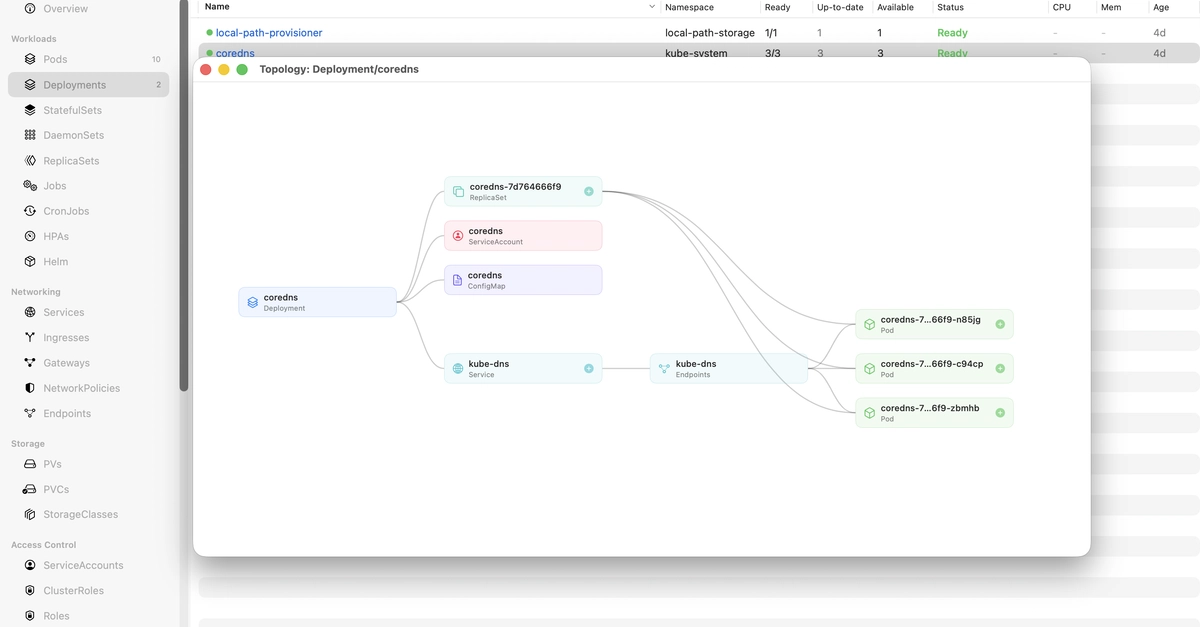
ArgoCD-style interactive graph showing Deployment → ReplicaSet → Pod → Service → Endpoints relationships. Drag nodes, expand/collapse, see the full picture.
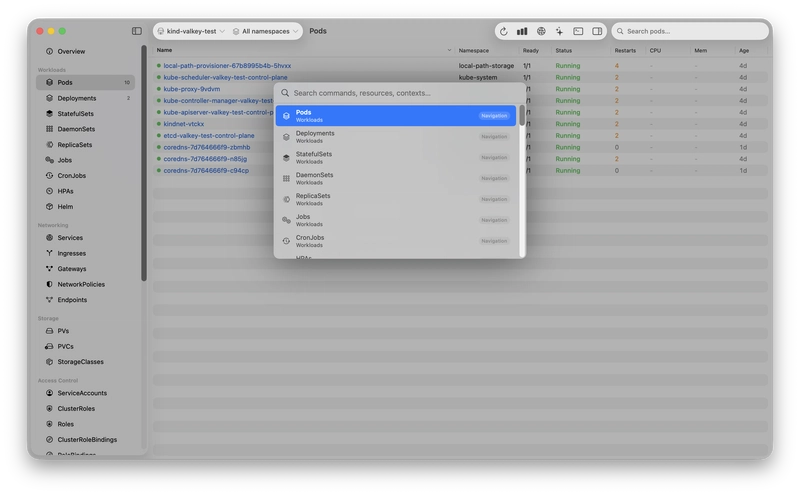
Instead of multiple dropdowns, Krust has a single search bar with typed filters:
This finds crashing pods in the prod namespace using more than 80% CPU. Works across all resource types.
Krust connects only to your Kubernetes API server. No analytics, no cloud accounts, no phone-home. Your kubeconfig stays on your machine.
Free forever: All 27 resource types, logs (single pod), terminal, port forwarding, YAML editor, Helm management, security audit, metrics, multi-cluster.
Pro ($9/mo): Multi-pod log aggregation, structured log parsing (JSON/logfmt), AI agent, topology graph, priority support.
Currently macOS 15+ (Apple Silicon and Intel). Windows and Linux are coming in April 2026.
UniFFI is production-ready. Mozilla's FFI generator for Rust → Swift/Kotlin/Python works well. The generated bindings are clean and the type mapping is predictable.
NSTableView still beats SwiftUI for large datasets. SwiftUI's Table re-renders the entire view on data changes. NSTableView only touches visible rows. For 1,700+ rows with real-time updates, this matters.
HTTP/2 multiplexing is underused. Most K8s tools open separate connections per resource watcher. A single HTTP/2 connection can multiplex all of them, reducing connection overhead and file descriptor usage.
Compact data models compound. Storing 700 bytes per pod instead of 70 KB means 100x less memory, but also faster sorting, filtering, and serialization across the FFI boundary.
If you manage Kubernetes clusters and want a GUI that doesn't tax your system, give Krust a try. I'm actively developing it and would love feedback.
Are you sure you want to hide this comment? It will become hidden in your post, but will still be visible via the comment's permalink.
For further actions, you may consider blocking this person and/or reporting abuse
DEV Community — A space to discuss and keep up software development and manage your software career
Built on Forem — the open source software that powers DEV and other inclusive communities.
Why it matters
News like this often changes audience expectations and competitors’ plans.
When one player makes a move, others usually react — it is worth reading the event in context.
What to look out for next
The full picture will become clear in time, but the headline already shows the dynamics of the industry.
Further statements and user reactions will add to the story.