6 Historical Royal Families More Dysfunctional Than the Targaryens — here is a clear breakdown of what happened and why it matters right now.
The details below put the news in context: the key points first, the background after.
Throughout the majority of Game of Thrones, families were pitted against another. The Starks versus the Lannisters. The Targaryens versus the Baratheons. But history was rarely ever that simple. For many kings, the greatest threat to their rule was not a foreign invader or a scheming noble, but a brother or cousin. House Targaryen is where George R.R. Martin shows that struggle best.
The Targaryens were often their own worst enemies, with infighting between cadet branches, disastrous sibling marriages, and a civil war that nearly killed off the entire bloodline. Few historical families were able to stay in power for as long as the Targaryens did, but nearly all that maintained power for more than a generation or two ended up falling apart from within.
Monarchies forced family members to become rivals for power, as siblings competed for inheritance and parents got too comfortable ruling in their children’s names. While the sources that survived to the modern day are often heavily biased against the dynasties that preceded them, it’s not impossible to believe even the most extreme conflicts could happen when familial affection was pitted against ambition.
These six families went down in history for the unusual and horrific things they were willing to do to each other for power.
The Ptolemaic Dynasty is one of the most obvious historical inspirations for the Targaryens, with a long history of incestuous marriage and civil war. Founded by one of Alexander the Great’s generals, the Ptolemaic family ruled Egypt for nearly 300 years. They began practicing incestuous marriages early, with Ptolemy II divorcing his non-related wife to marry his sister—who was inconveniently also his first wife’s step-mother. It only got more chaotic from there.
In 164 BC, Egypt was officially ruled by Ptolemy VI and his sister-wife Cleopatra II. However, a series of foreign conflicts led to their brother, the future Ptolemy VIII, going to war with them. Ptolemy VI died several years later, and Cleopatra named her son as the new ruler. Ptolemy VIII arrived home and convinced his sister to marry him, only to murder his new step-son at their wedding and refuse to give his sister any power. If that wasn’t enough, he then cast Cleopatra to the side to marry her daughter, who was his double-niece from both his sister and brother.
After a series of incestuous marriages, murders, and civil wars, the Ptolemaic Dynasty came to an end with the infamous reign of Cleopatra VII. Cleopatra was married to her younger brother Ptolemy XIII, but they ended up going to war against each other for the throne. Cleopatra came out on top thanks to the intervention of Rome, and she began her affair with Julius Caesar in addition to another sibling marriage with Ptolemy XIV. That brother died under mysterious circumstances a few years later, allowing Cleopatra’s child with Caesar to become Heir—until he was executed by Augustus Caesar, who was his adoptive brother via Caesar and his step-father Marc Antony’s brother-in-law.
Queen Anula was the first known female monarch in Asia, but the journey she took to get that title involved some very complicated family dynamics. Anula married Chora Naga, who was King of Anuradhapura from 62 to 50 BC. according to the data the Mahavamsa, she poisoned her first husband and married his cousin, Kuda Tissa, to remain queen. Unhappy with that dynamic, she then poisoned Kuda Tissa and subsequently married and murdered four other men.
In each of these instances, Queen Anula effectively gave the throne to her husbands to justify her own power. The men seemed to get the better end of the deal—marry a beautiful woman and become king—but Anula ensured that she was always the one in control. She weaponized the concept of marriage and family to pursue her goals, frequently marrying men from lower social classes who would not have the connections to stand against her.
By 47 BC, Anula no longer needed to acquire power through marriage. She simply declared herself queen regnant. If she had produced an heir with one of her husbands, that status might have been tolerable. Instead, she was deposed and killed by her first husband's cousin. If she’d had children with each of her husbands, it would likely have prompted a succession crisis that would put the Dance of the Dragons to shame.
Herod the Great is best known as the King of Judea during the time of Jesus’s birth, but while his infamous slaughter of infants has little historical evidence, his terrible personal life was well-documented. Herod married a woman named Doris sometime in his early life and had a son with her. However, after being named King by Rome, Herod cast his first wife and son aside to marry Mariamne, a member of the former ruling family.
However, Mariamne’s mother was supposedly plotting to overthrow him in favor of her son, Aristobulus. Once Herod felt he had enough evidence of this betrayal, he had Mariamne, her mother, and her brother killed. His two sons with Mariamne were upset by this, so Herod brought his eldest son back and named him as his heir. When that didn’t seem to be enough, Herod had his sons killed.
After this incident, Herod took up to eight other wives, who produced as many as fourteen children for him. Not much is known about their family until the end of Herod's life, when he became increasingly paranoid and had his eldest son executed for treason against him. He divided his territory among three of his remaining sons and his sister, who had further conflicts amongst themselves. Herod's terrible parenting resulted in a divided kingdom, one son stealing the other's wife, and a legacy of blood and Roman submission.
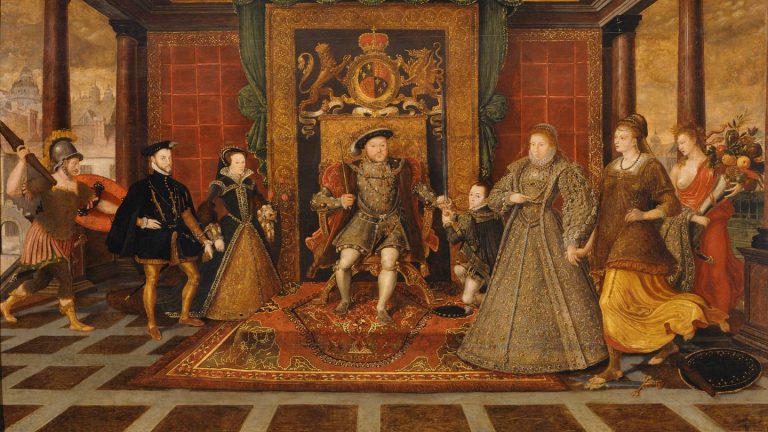
English history is full of dysfunctional families, but since George R. R. Martin’s work already leans heavily on the Anarchy and the War of the Roses, we’re going a bit later to look at the crazy family dynamics of House Tudor.
The House came to power with Henry VII, who claimed the throne by defeating his distant cousin Richard III at the Battle of Bosworth Field. In addition to being descended from the royal Lancastrian line, Henry cemented his legitimacy by marrying Princess Elizabeth of York, whose brothers were the legendary Princes in the Tower, suspected to have been killed by either her uncle Richard or her future husband’s supporters.
The next part of the story is better known, but no less convoluted. Henry and Elizabeth had a son named Arthur who was betrothed to and eventually married Katherine of Aragon. He then died five months later, but Henry didn’t want to give back her dowry. Rumors spread that he considered marrying the teenage widow himself, but he eventually sought papal approval to marry Katherine to Arthur’s younger brother, the future Henry VIII.
They remained married for nearly 24 years before Henry got antsy about his only legitimate child being female. His solution made the family tree messier than ever. Henry technically married Anne Boleyn before annulling his marriage to Katherine, but once the marriage was annulled, it was considered never to have happened. This meant that their daughter, Princess Mary, was suddenly deemed illegitimate. To punish Katherine for refusing to accept his new marriage, Henry also refused to let Mary visit her mother ever again.
A similar process, though much more aggressive, took place when Henry decided to move on from Anne. In addition to taking her head, Henry had their marriage annulled as well—in part because he had previously been intimate with her sister. There were also rumors at the time that he had slept with the Boleyn girls’ mother. When his marriage to Anne was annulled, his daughter Elizabeth was also made illegitimate.
Over the years (and another four wives), the two princesses were brought back into the royal family. But their legitimacy was always in question, which caused problems after Henry died. His obvious successor was his son Edward, who was crowned at nine, but Edward only survived six years of his reign. He tried to keep the crown from his sisters by giving it to his cousin, Lady Jane Grey, but Mary had Jane executed after ending her nine-day reign. She only ruled for five years before dying herself, passing the throne to her half-sister Elizabeth.
The entire kingdom was at the mercy of one of the most dysfunctional families in history, swinging between Catholicism and Protestantism with a lot of blood spilled along the way.
Like many women throughout history, Kösem Sultan began her life on the world stage in a precarious position. As one of Sultan Ahmed I’s wives, she had little political power in her own right. However, she was skilled at winning affection and soon acquired a great deal of influence as the Sultan's chief consort.
That power was endangered when Ahmed died in 1617, as Kösem could only keep her power if one of her sons took the throne. The Ottoman Empire historically prevented civil wars by having the new Sultan execute all of his brothers, but Ahmed had refused to do so when he took the throne. Since her sons weren't ready to rule, Kösem advocated for Ahmed’s teenage brother Mustafa to succeed him, since Ahmed’s sons were more likely to see her children as a threat. However, due to his age and alleged mental illness, he was easily deposed in favor of Ahmed's eldest son, Osman II.
While this could have been disastrous for Kösem, Osman did not immediately kill his half-siblings. He seemed to have a relatively positive relationship with Kösem, which she used to keep her eight children safe. Osman was eventually assassinated, leading to Kösem’s son Murad IV taking the throne.
Murad was only 11 when he became Sultan, which allowed his mother virtually unchecked power for five years as his regent. Though her power waned when he came of age, she continued to exercise influence until his death in 1640 brought his younger brother İbrahim to the throne. Murad had killed all of his other brothers, only allowing İbrahim to live because of his mental instability. But the infirmity that kept him alive made İbrahim a poor ruler, so his mother conspired with court officials to kill him.
With both of her sons dead, Kösem should have lost control of the court, as the mother and wife of the current Sultan were typically the most influential women during his reign. However, Kösem created a position for herself as the grandmother of the new Sultan, Mehmed IV. She and Mehmed’s mother, Turhan Sultan, fought for control over the six-year-old ruler. As Turhan gained power, Kösem considered having her grandson murdered, since Mehmed's younger brother had a less ambitious mother. But Turhan was faster, having Kösem murdered in 1651.
The woman who would become Catherine the Great was born as Princess Sophia, daughter of Prince Christian Augustus of Anhalt-Zerbst and Duchess Joanna Elisabeth of Holstein-Gottorp. She had an unhappy childhood, as her parents had little affection for each other and were bitterly disappointed at their firstborn being a girl. Duchess Joanna began searching for a husband for her daughter when the girl was only eight years old.
Joanna found an attractive option in Peter Ulrich, an orphaned boy who seemed likely to inherit the throne of Russia. She leveraged her family's relationship with Empress Elizabeth to get the betrothal approved, but as the plans for Sophia’s marriage to Peter advanced, Joanna decided to become a spy for the king of Prussia. When her scheming was discovered, Joanna was exiled from Russia, never to see her eldest child again.
This left Sophia, now renamed Catherine, in a vulnerable place. She had hated her intended husband from the first time they met, and she was now on her own in another country. Worse still, Peter was reportedly incapable of consummating the marriage and generally ignored his wife. Catherine eventually conceived and bore a son, Paul, but it has always been questioned whether he was actually Peter’s son or the child of one of Catherine’s lovers.
While most queens would have contented themselves with building their own power base, Catherine was determined to rule Russia. She made friends, gathered allies, and began to scheme against Peter’s aunt, the Empress. Though she was unable to topple Elizabeth, she had better luck against her husband. About six months after Elizabeth’s death, Catherine launched her coup, arresting her husband and forcing him to abdicate the throne. Peter died eight days later.
Catherine was now the most powerful woman in Russia, and her reign was revolutionary. But her personal life remained complex. Empress Elizabeth had taken Catherine’s son away from her shortly after his birth, and his tutors taught him to resent his mother. She didn’t help matters by sending away his mistress and illegitimate child, taking custody of his legitimate children, and considering skipping Paul in the line of succession in favor of his son, Alexander.
When Catherine died, Paul seemed determined to undo her reign. He had his father’s body reinterred with a grand funeral and enacted the Pauline Laws, which prevented a woman from ever ruling Russia again. Paul’s son, Alexander, saw his father as a poor ruler and seemingly agreed to a coup that would remove his father from power. Paul was attacked in his bedroom, and while his attackers tried to get him to abdicate, they eventually killed the emperor. While Alexander supposedly opposed his father’s assassination, he did not punish the killers, accepting the throne and moving forward.
Blood may be thicker than water, but royal blood doesn't seem to guarantee familial loyalty.
About the Author