
The topic of AI-led job cuts don’t always mean stronger ROI — Gartner is currently the subject of lively debate — readers and analysts are keeping a close eye on developments.
This is taking place in a dynamic environment: companies’ decisions and competitors’ reactions can quickly change the picture.
Businesses tend to eye AI spending as a way to reduce headcount, but firms that cut staffers as a result of AI are doing no better than those who don’t, according to the data new Gartner research.
Gartner recently surveyed 350 global business leaders at large organizations already using AI agents and intelligent automation tools and found that 80% of them reported a lowered headcount as a result of AI initiatives — in some cases by up to 20%.
But those layoffs appear to be less beneficial than senior leaders might assume.
“There’s no connection or correlation between people who are achieving ROI and layoffs,” said Helen Poitevin, distinguished vice president analyst at Gartner, adding that labor reduction is “not the best” ROI metric. Other factors such as revenue, growth, and time to market are more effective in achieving a strong ROI.
“Those who only look to the workforce tend to be the ‘laggards,’ because they’re not going after the broader set of value that they can get to,” she said. This approach can also be “very disruptive more broadly,” she said, noting that some organizations who cut staff were forced to quickly rehire employees soon after.
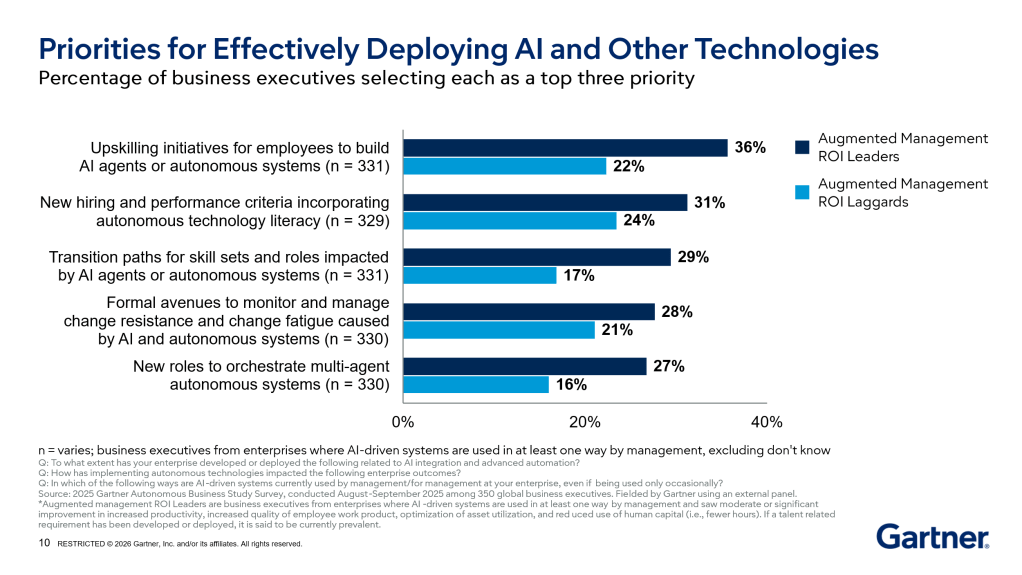
That’s not to say companies aren’t cutting jobs, said Poitevin, but doing so isn’t the main route to solid ROI. Instead, organizations with higher levels of return on their spending looked beyond workforce reductions and saw AI as a way to improve employee productivity.
These organizations are more likely to upskill staff to use AI tools, link employee hiring and performance criteria to AI proficiency, and set “transition paths” for skill sets and roles that will be affected by automation plans, said Poitevin.
“You have to plan for layoffs where they happen, but, more importantly, you have to plan for workforce transformation, and you have to go after broader forms of value through your AI investment portfolio than just labor cost,” she said.
For those panicking at the prospect of an AI-led jobs apocalypse, Gartner offers some hope: The analyst firm predicts that by 2029 the number of jobs created by AI will outpace those that are lost.
Between 2023 and 2029, approximately 6 million roles will be automated globally, as businesses deploy AI agents and other intelligent automation technologies, according to the data Gartner; that’s a small proportion of the roughly 2 billion jobs available to workers.
The prediction adds to a growing expectation among industry watchers that AI will reshape the workplace rather than replace workers en masse, at least for the foreseeable future. “AI is not leading to a jobs apocalypse, but it’s unleashing job chaos, changing the shape of what people do,” said Poitevin.
That doesn’t mean disruption can be avoided entirely. A larger portion of the workforce — around 32 million workers each year — will see their roles transformed with the introduction of AI and intelligent automation, forcing them to “rethink what they do, how they do it, what ‘good’ looks like,” said Poitevin.
At the same time, the deployment of AI is expected to generate new labor demand in 2027 and 2028, with that demand offsetting AI-related job cuts the following year.
The AI-led job gains will include higher demand for existing roles boosted by AI-driven productivity gains, as well as the creation of new roles related specifically to the deployment and management of AI systems – change management and business transformation, for example.
Wider adoption of AI tools will also lead to the emergence of new business models, according to the data Gartner – similar to higher demand for logistics systems and delivery drivers after the e-commerce boom or the increase in financial analysts after Excel replaced old-fashioned bookkeeping.
Why it matters
News like this often changes audience expectations and competitors’ plans.
When one player makes a move, others usually react — it is worth reading the event in context.
What to look out for next
The full picture will become clear in time, but the headline already shows the dynamics of the industry.
Further statements and user reactions will add to the story.