The topic of Suggix Weekly: Stop Building Everything: Let Users Decide What Matters is currently the subject of lively debate — readers and analysts are keeping a close eye on developments.
This is taking place in a dynamic environment: companies’ decisions and competitors’ reactions can quickly change the picture.
One of the most common traps founders fall into—especially indie hackers and small SaaS teams—is believing that every piece of user feedback should become a roadmap item.
A user asks for a feature. It sounds reasonable. Maybe even urgent.
So you build it.
Then another request comes in. And another.
Before long, your product becomes a patchwork of half-used features, your roadmap is bloated, and your velocity slows to a crawl.
The hard truth is this:
Not all user feedback should be built.
The real skill isn’t listening to users—it’s knowing what not to build.
The Feedback Fallacy in Feature Prioritization
We’re often told to “listen to your users.”
That advice is correct—but incomplete.
Users are great at identifying problems:
“This workflow is slow”
“I wish I could export this”
“This doesn’t integrate with X”
But they are not always good at proposing solutions.
When you treat every suggestion as a feature request, you end up:
Solving symptoms instead of root problems
Building edge-case features for a few loud users
Losing clarity on your product’s core value
In other words, you stop building a product—and start managing a backlog.
A Real SaaS Problem: Backlog Overload
A small SaaS team (12 people) once shared their situation publicly:
They had accumulated over 1,000 feature requests.
At first, it felt like progress—users were engaged, feedback was flowing.
But internally:
No one knew what to prioritize
Engineers were constantly context-switching
Product decisions became reactive instead of strategic
Most importantly, very few of those 1,000 requests actually mattered.
They weren’t building what was important—they were building what was visible.
Signal vs Noise in User Feedback
User feedback is not equal.
It’s a mix of:
High-signal insights → core product gaps
Low-signal noise → preferences, edge cases, one-offs
Without a system to separate the two, everything feels equally important.
And when everything is important, nothing is.
Feature Prioritization Starts with Validation
Instead of asking:
“Should we build this feature?”
Ask:
“How many users actually need this?”
This is where most teams fail.
They collect feedback—but don’t validate demand.
A single request ≠ a real problem
A repeated pattern across users = opportunity
Let Users Vote: A Better Way to Prioritize Features
One of the simplest but most effective ways to manage user feedback is this:
Stop collecting feedback in isolation. Start aggregating it.
When users can see and vote on existing requests:
Duplicate ideas collapse into one
Demand becomes measurable
Priorities become obvious
Instead of 50 scattered requests, you get:
One request with 120 votes.
That’s signal.
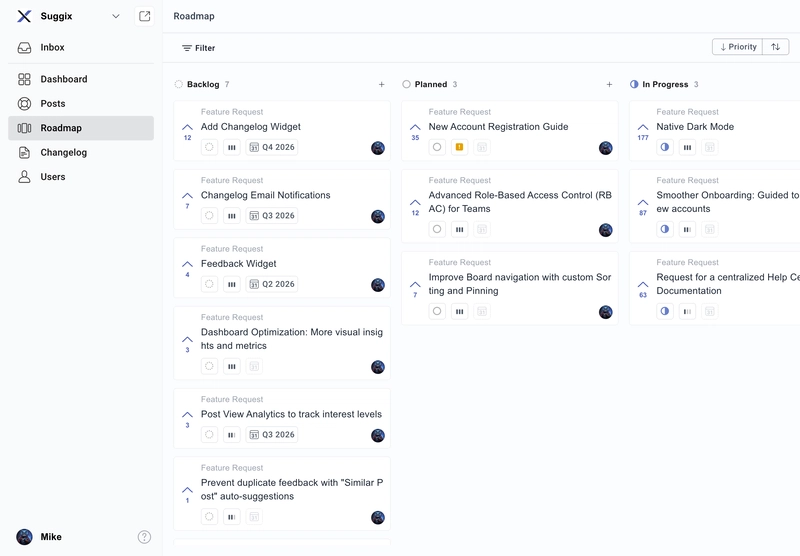
Tools like Suggix are designed around this exact model—helping teams centralize feedback, merge duplicates, and prioritize features based on real user demand instead of assumptions.
Case Study: From Chaos to Clarity
An early-stage SaaS product introduced a public feedback board with voting.
Before:
Feedback was scattered across email, chat, and support tickets
Ideas were tracked manually in spreadsheets
Prioritization relied on gut feeling
After:
All feedback lived in one place
Users voted on existing ideas
The team quickly identified the top 5 most requested features
The result:
They shipped fewer features—but saw significantly higher adoption.
Because they were finally building what users actually cared about.
Why More Features ≠ More Value
There’s a common assumption in SaaS:
More features = more value
In reality:
More features → more complexity
More complexity → worse UX
Worse UX → lower retention
Great products don’t win by doing more.
They win by solving a small number of problems extremely well.
The 80/20 Rule in Product Usage
In most SaaS products:
20% of features drive 80% of usage
The rest are rarely touched
Yet teams spend most of their time building the 80%.
Why?
Because those features are:
Easier to implement
More visible (users explicitly request them)
Less risky than making bigger decisions
But optimizing for “easy wins” leads to long-term stagnation.
A Practical Feature Prioritization Framework
To prioritize effectively, evaluate every request across three dimensions:
FAQ: Feature Prioritization & User Feedback
How do you prioritize feature requests in SaaS?
Use a combination of:
User demand (votes or frequency)
Business impact (retention, revenue)
Product alignment
Avoid prioritizing based on individual requests alone.
Should you build every user request?
No.
Most user requests represent symptoms, not solutions.
Focus on identifying patterns instead of reacting to isolated feedback.
What is the best way to manage user feedback?
The most effective approach is to:
Centralize feedback
Aggregate similar requests
Let users vote
Prioritize based on validated demand
Platforms like Suggix help automate this process and turn feedback into clear product decisions.
Final Thought
Building a great product isn’t about doing more.
It’s about doing the right things.
Your users don’t need you to build everything they ask for.
They need you to understand what truly matters—and deliver on that.
So the next time a feature request comes in:
Pause.
Measure.
Validate.
And let your users decide—together—what’s actually worth building.
One of the most common traps founders fall into—especially indie hackers and small SaaS teams—is believing that every piece of user feedback should become a roadmap item.
A user asks for a feature. It sounds reasonable. Maybe even urgent.
Are you sure you want to hide this comment? It will become hidden in your post, but will still be visible via the comment’s permalink.
For further actions, you may consider blocking this person and/or reporting abuse
DEV Community — A space to discuss and keep up software development and manage your software career
Built on Forem — the open source software that powers DEV and other inclusive communities.
Why it matters
News like this often changes audience expectations and competitors’ plans.
When one player makes a move, others usually react — it is worth reading the event in context.
What to look out for next
The full picture will become clear in time, but the headline already shows the dynamics of the industry.
Further statements and user reactions will add to the story.