
The topic of How Southwest Airlines is putting endpoint operations on autopilot is currently the subject of lively debate — readers and analysts are keeping a close eye on developments.
This is taking place in a dynamic environment: companies’ decisions and competitors’ reactions can quickly change the picture.
As digital tools become more central to its operations, Southwest Airlines is increasingly turning to AI and automation to prevent endpoint issues from affecting the sprawling airline.
The new tools allow the company’s IT team to take a more strategic, rather than reactive, approach to operations, said Derek Whisenhunt, head of end user computing at Southwest Airlines.
“Bottom line is we now focus our team’s time on proactive and preventative work and increasing the digital employee experience and not waiting for issues to arise before focusing on them,” said Whisenhunt.
Southwest has been steadily digitizing frontline workflows for the past decade, replacing paper-based operational processes with mobile devices and cloud applications for its maintenance, flight operations, and gate services workers — and even cabin crews.
The Dallas-based company has largely digitized operations for its 72,000 staffers — two-thirds of which are in frontline roles — replacing the printed manuals used by pilots and ground operations teams with mobile devices, for instance.
At the same time, the switch to digital tools has placed even greater demands on IT: the Southwest end user computing team supports around 50,000 employee smartphones and tablets, 20,000 laptops, and 15,000 PCs.
Problems with end user devices can be costly to the business. With short turn-around times for Southwest’s 800 Boeing 737 aircraft, hardware or software failures on employee devices can quickly affect airline customers.
“You’ve seen it, or you’ve experienced this,” said Whisenhunt. “If you go up to a customer service or a gate agent and you can see the line start to extend — or the customers start to get frustrated and the agent’s on the phone with somebody — that’s either a ticket issue or it’s a system issue.
“To me, it’s very personal, because we’re impacting the employees’ experience, we’re impacting our customers’ experience,” he said. “In just that one scenario, we’re drastically impacting our ability to turn aircraft.”
To monitor and manage its fleet of end-user devices, Southwest deployed a digital employee experience (DEX) application from Nexthink several years ago. DEX software is designed to monitor and improve how employees interact with workplace technologies, including device performance, application reliability, and IT support interactions.
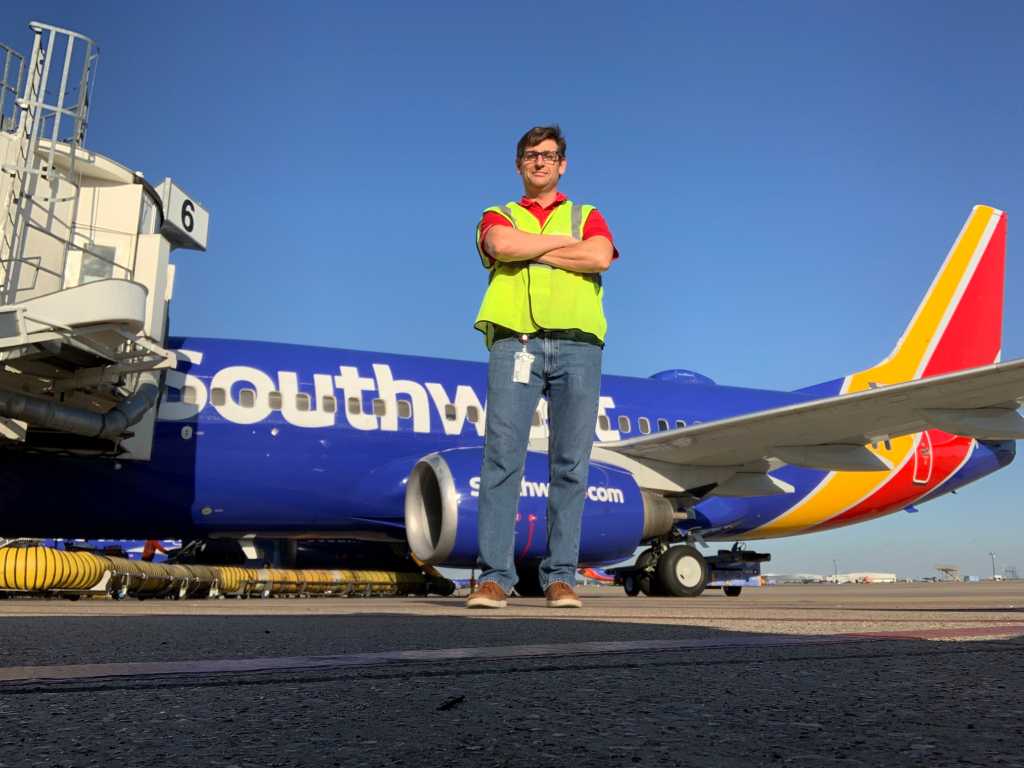
In recent years Southwest has become more advanced in its use of DEX software, said Whisenhunt. Within its 14-strong endpoint management team, Southwest now has a “full-blown DEX operations team” and a DEX engineering team — with an additional 12 employees — that’s “forward-looking, deploying new products” and managing automations, said Whisenhunt..
In addition to gathering insights into the performance of devices, Southwest now uses DEX to actively remediate problems. Automation plays a key role here, with Southwest using “remote actions” to automate simple fixes, such as cleaning cache files that had caused Microsoft Teams to crash for users.
The volume of remote actions deployed by the airline has grown significantly in recent years. In 2024, the company conducted 1.1 billion remote actions, equivalent to roughly 13,000 hours saved for employees dealing with IT problems. In 2025, the remote action figure rose to 2.1 billion — with 23,000 hours saved, he said.
“That’s how important a remote action is.… It’s in that preventative world, where we’re addressing an issue before you even know it.”
Automated remote actions have also helped Southwest avoid hardware upgrades, said Whisenhunt.
The airline has around 8,000 back-office PCs, with as many as 20 employees logging in to each one. Because full Microsoft 365 profiles are downloaded when a user logs in, the PC hard drives fill up and cause performance issues. Remote actions were used to delete user profiles for employees that hadn’t logged in for a week or more – averting the planned purchase of 1-terabyte hard drives to deal with the demands, said Whisenhunt.
Remote actions can also be combined into automated workflows using ‘if/and’ statements to perform more complex actions.
Over the last month or so, Southwest has automated approximately 5.8 million remote actions “across a range of endpoint health, security, and lifecycle workflows,” said Whisenhunt, the majority of which center on disk space management, with 13 remote actions executed roughly 3 million times to “proactively reclaim disk space.”
The team was able to address a 20% failure rate for its Microsoft SCCM client — used for software and security updates on employee devices — chaining together several remote actions to check the health of the client, restart the service, and, if needed, repair or reinstall the client software.
The DEX platform also integrates with ServiceNow to enable automated ticket generation when users run into technical problems.
“for example, if we see your system had three blue screens of death in 24 hours, a ticket is automatically generated,” he said, working around any employees who would rather put up with the inconvenience than file a trouble ticket.
“A lot of people don’t even call the service desk, they’re like, ‘Whatever – reboot, just deal with it. I don’t have time for this.’”
In addition to workflow automation, Whisenhunt said AI tools could help boost productivity. Nexthink’s Workspace — an LLM-based conversational assistant — lets staff quickly find information about problems affecting their devices, and can provide guidance around what tasks to prioritize.
That’s helped the end user computing team access relevant data faster, he said, “while allowing our analysts and our engineers to focus on what’s more important.”
The team uses Workspace daily, he said, to monitor device health, application performance, security posture, and lifecycle signals. It’s also used to trigger remote actions to correct issues “often before the employee is aware there’s a problem,” said Whisenhunt.
“This has shifted the team from a ticket‑driven, reactive support model to a proactive operations model where we can detect degradation, validate remediation outcomes, and continuously improve stability at scale,” he said. The result has been a reduction in service desk volumes, “faster time‑to‑resolution when issues do surface, improved endpoint reliability, and meaningful recovery of engineering capacity previously spent on repetitive fixes.”
Southwest plans to roll out Nexthink’s Spark — an AI tool designed to tackle user problems by diagnosing and suggesting simple fixes before contacting IT. A pilot rollout is in the works, said Whisenhunt, starting with the IT team.
“By combining real‑time context from the endpoint with IT‑approved automation and guided remediation, Spark allows users to resolve many issues themselves, in the moment, without opening a ticket or waiting for human intervention,” he said.
Beyond the potential productivity boost, Whisenhunt is taking steps to mitigate possible AI downsides. ‘As with any AI‑driven capability in an enterprise IT environment, we do have healthy concerns around reliability, oversight, and ensuring the right balance between automation and control,” he said
“We are treating trust as something that must be earned over time through strong governance, clear guardrails, and continuous validation of outcomes rather than assuming it from day one.”
Why it matters
News like this often changes audience expectations and competitors’ plans.
When one player makes a move, others usually react — it is worth reading the event in context.
What to look out for next
The full picture will become clear in time, but the headline already shows the dynamics of the industry.
Further statements and user reactions will add to the story.