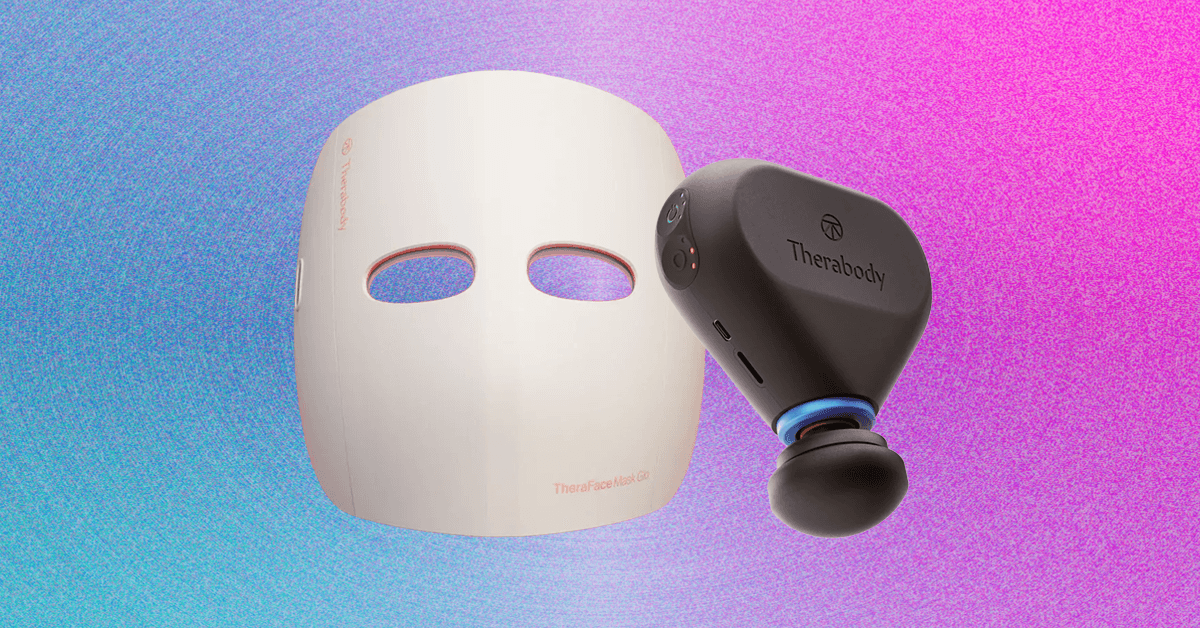
Theraguns are the gold standard for massage guns, so much so that the name has become synonymous with the category. But Therabody, the innovative company behind Theragun, has expanded its repertoire to boost wellness for more than just sore muscles and pain relief. It now offers a suite of gadgets to alleviate eye strain, soothe menstrual cramps, and depuff your skin (to name a few). We haven’t tried every product in their lineup—we’re getting there—but we’ve put several to the test, and these are our favorites. Plus, most of these gadgets are FSA/HSA eligible and designed with USB-C charging.
While Theraguns are an excellent investment for active individuals, it’s worth noting that percussive massage guns are available at lower price points. If you’re not married to the Therabody brand, see our Best Massage Guns for alternative recommendations that won’t break the bank.
Updated March 2026: I’ve added the Theragun Mini Plus, the JetBoots Pro Plus, the SleepMask, and the TheraFace Mask Glo as new favorites. I updated the Honorable Mentions section with more products. Prices and links were also updated.
If you’re looking for a professional-grade massage device, the Theragun Pro Plus is especially favored by college athletic departments and pro sports teams. It’s one of the most advanced percussive guns on the market, incorporating vibrations, heat, and near-infrared LED therapies for an all-in-one recovery tool. It also offers cold therapy, but you’ll have to purchase an additional attachment for $100, which is steep for what is already a splurge. After testing the attachment myself, I don’t think it justifies the cost unless you want the contrast therapy.
Priced at $650, this is the most expensive Theragun, so I’d recommend it to athletes or those who are dealing with chronic muscle pain and want the LED therapy. For casual users, some of the features might feel like overkill. For example, there’s a built-in biometric sensor for heart rate tracking that I have barely used. I do, though, appreciate the OLED screen, which displays a force meter, so you can see exactly how much pressure you’re applying. It’s a useful feature if you need a nudge to apply more pressure or a reminder to ease up.
The Theragun Relief was the last of 2023’s devices and remains the cheapest Theragun so far—priced even lower than the Mini Plus. For the price tag, you’re sacrificing some of the premium features, like the LCD screen and Bluetooth connectivity to the Therabody app for device control. But you can still follow guided routines on the app, and the simple one-button control is refreshing to use.
There are three head attachments and three speed settings, which is a step down from the standard five speeds and 4+ attachments; still, the Relief is less than half the weight of the Pro Plus, and it’s equipped with the essentials, which is more than enough for the average person.
The original Theragun Mini is still a solid portable device—and it’s $60 less—but the Mini Plus feels like a shrunken version of the elite Pro Plus. The ergonomic triangular design lets me target trigger points and muscle groups like my hamstrings and calves with more pressure control, though that same shape makes it awkward to use on my lower back. Thoughtful details, like a travel lock to prevent it from powering on and a compact carrying pouch, make it easy to carry on commutes and flights.
Most notably, it brings heated percussive therapy to a travel-friendly device. The heat therapy is easily my favorite feature on the Pro Plus. The Mini Plus is also compatible with Therabody’s Vibration Plus and Cold Plus attachments (both sold separately).
Note: Some customers have reported charging issues, saying their units wouldn’t power up, but I haven’t run into any battery problems in my two weeks of testing. I’ll update this review if anything shifts with long-term use.
The JetBoots Pro Plus are full-length, wireless boots that combine pneumatic compression with vibration therapy and infrared LED light. Everything is controlled from a built-in LCD screen and control panel on the lead boot, and connectivity is effortless; they automatically link when powered on.
There are eight preset programs targeting legs, knees, and joints, but you can manually adjust pressure, intensity, and the session length. Sessions can run from 10 to 60 minutes in five-minute increments, with compression adjustable between 20 and 100 mmHg (millimeters of mercury). Vibration offers three intensity levels (low, medium, and high), and the infrared LED setting is a simple on or off, with an automatic shutoff after 45 minutes.
The JetBoots Pro Plus are TSA-approved for carry-on travel, but keep in mind they’re still pretty hefty. Inside, a nonporous proprietary material reduces moisture and microbial buildup, and after months of testing, I haven’t noticed any lingering odors. These are best suited for athletes, frequent travelers, or anyone managing circulation-related conditions like lymphedema, deep vein thrombosis (DVT), and chronic venous insufficiency (CVI).
I enjoyed the original TheraFace Mask, but the upgraded TheraFace Mask Glo feels like the smarter purchase. It’s easier to find (Therabody seems to be phasing out the original), costs $270 less, and is slightly lighter at 1.13 pounds versus the OG’s 1.27. While the Glo has fewer LED bulbs—504 compared to 648—the difference doesn’t translate to a lesser treatment. You get the same red, infrared, and blue light wavelengths, plus the signature vibration therapy that made the first-generation mask stand out.
The vibrations are now integrated into the adjustable straps rather than the mask itself. They’re usually distracting, occasionally even headache-inducing, depending on my mood. I usually skip the vibration setting altogether. Even without it, the Glo remains competitively priced among high-end LED masks.
Treatment sessions range from four to 12 minutes, and the removable eye shields are thoughtful, but I prefer taking them off to extend the light coverage to my under-eye area. I very much appreciate the cordless design, but I do miss the display stand that came with the original. I often end up storing it back in its box, which makes me less inclined to reach for it. You can purchase a travel case for $80.
I challenge you to stay awake through a full session with the SmartGoggles 2.0. I’ve been testing them for months, and more often than not, they knock me out. The combination of gentle heat, vibration, and massage therapy across my forehead, eyebrows, and temples relaxes my facial tension within minutes. I love wearing them when I have a headache from staring at screens all day, and while I don’t struggle with regular migraines, I can see them being a soothing blackout remedy in a quiet, dark room.
Former reviewer Medea Giordano loved the first model (9/10, WIRED Recommends), and this upgrade betters the fit with contoured padding that feels similar to Therabody’s SleepMask. You still get three preset modes: Focus, Sleep, and SmartRelax. The latter uses biometric feedback to adjust vibration patterns based on your heart rate. It also syncs with the Therabody app, letting you tweak the vibration and heat intensities or incorporate sound therapy. Note, though, if you’re a side sleeper, you’ll have to shift around, as these are most comfortable while lying flat on your back.
I’ve tested a couple of sleep masks, and the TheraFace SleepMask is one of my favorites. Many claim to be 100 percent blackout, but this one leaves me totally disoriented when I wake up, with no idea what dimension I’m in—just how I like it. The contoured padding feels plush, and the adjustable strap keeps the mask in place without tugging at my hair, even when I shift around at night. It comes with a carrying case, so I always pack it for travel.
The selling point is that this mask uses vibrations—three pattern presets (Pulse, Wave, Constant)—designed to nudge your brain into deeper rest. I struggle with staying asleep, but when I wake up in the middle of the night, I just tap the button to start a 15-minute session, and it usually lulls me back to sleep. That said, the vibrations are almost too gentle; you barely feel them, but you can absolutely hear them. It’s not as soothing as a white noise machine, so if you’re a light sleeper, this might be a deal-breaker.
The TheraFace Depuffing Wand has become a staple in my travel bag. It delivers both hot and cold therapy to help reduce puffiness, improve circulation, and enhance product absorption before completing your skin care routine. It’s TSA-friendly—zero awkward bag checks and counting—and ideal for tackling under-eye bags after a long flight or night. The curved applicator reaches every contour of my face, and the precision tip is great for trickier spots like under my eyes. It’s intended to be used on clean, dry skin, so I hold the opposite side of my face to prevent tugging.
The wand comes with three preset temperature levels that feel gentle but effective. While the cold function isn’t as icy as a roller fresh from the freezer, it’s consistent throughout a six-minute session and doesn’t drip. Plus, they won’t crack if you forget to take them out of the freezer (RIP to two of mine). An indicator light flashes at three minutes to remind you to switch sides, but it’s easy to miss if you’re not looking straight into a mirror.
Cupping is an ancient healing technique that draws blood flow to the affected area to speed healing. Therabody’s version combines suction, heat, and vibration therapy for localized recovery. With three levels of suction (30, 40, and 50 kilopascals, or kPa), three heat intensities (41, 43, and 45 degrees C), and three vibration modes (low, high, and wave), I appreciate how you can customize how intense (or gentle) you want your session to be. The TheraCup is also programmed with an auto-shutoff after three minutes—so you don’t overdo any area—and built-in safety sensors that will cut off the pressure if it exceeds 60 kPa.
TheraFace Mask for $650: The TheraFace Mask is a cordless, hands-free light-therapy device that uses three wavelengths (red, infrared, and blue) to tackle different skin care needs. To distinguish itself from its competitors, the TheraFace Mask includes a built-in vibration therapy mode that massages pressure points around the eyes, brow line, and scalp for some added stress relief. It comes with removable eye shields and a sleek display stand, which makes it easy to store on your nightstand.
JetBoots Prime for $550: Compared to the JetBoots Pro Plus, the JetBoots Prime keeps it simple: You get four pressure levels (25, 50, 75, and 100 mmHg) and three durations (20, 40, or 60 minutes), all adjustable throughout your session through a built-in control panel. They’re wireless with a 180-minute battery life and can even be used while charging. Plus, they fold down into the included drawstring bag, making them portable and fuss-free to stow away.
WaveRoller for $180: Foam rollers are great for improving range of motion, increasing blood flow, and reducing muscle tension. You can buy a decent foam roller for significantly less, but the WaveRoller offers Therabody app integration for a personalized experience and five vibration frequencies. Designed for full-body use, it works best for warm-ups and post-workout recovery.
TheraFace Pro for $420: The TheraFace Pro includes six detachable magnetic heads for cleansing, microcurrent, percussive massage, and LED light therapy—blue light for acne, red light, and infrared for anti-aging. Former reviewer Haley Sprankle tested the facial device and said her skin was softer and brighter, but she also noted that no clinical studies prove that microcurrent is an effective facial treatment.
Theragun Mini (3rd Generation) for $220: I recommend the Mini if you’re new to percussive therapy or need something packable for travel. It’s the smallest and lightest Theragun, with three attachments (standard ball, dampener, and thumb) and a soft-zip case that fits into a tote, gym bag, or carry-on.
Theragun Sense for $300: The Theragun Sense is slightly smaller (and lighter) than the Pro Plus, and it’s also impressively quiet. Some settings are almost silent, allowing for a discreet recovery session at whatever time of day without having to worry about bothering your housemates. It has the same LCD screen and breathwork features as the Pro Plus, too. The main difference here is that it’s compatible with fewer attachments, but four heads are still more than enough for the active individual.
Theragun Pro (5th Generation) for $530: Therabody still sells a few older generations as well as refurbished models directly. You may find even older models for sale on Amazon. While we haven’t tried them all, we think it comes down to price. Anything older than 2019 or 2020 releases might not be worth it unless the price is shockingly low. This Pro came out in 2022, so it’s still a decent deep tissue massager. If you can find it on sale and don’t need all the latest updates, you should be happy with this one over the Pro Plus.
I’ll be testing the Theragun Prime (6th Generation) for $330, the RecoveryTherm Cube for $160, and the RecoveryPulse Arm for $160.
Power up with unlimited access to WIRED. Get best-in-class reporting and exclusive subscriber content that’s too important to ignore. Subscribe Today.