
The topic of Gemini Enterprise update brings AI agents into collaborative workflows is currently the subject of lively debate — readers and analysts are keeping a close eye on developments.
This is taking place in a dynamic environment: companies’ decisions and competitors’ reactions can quickly change the picture.
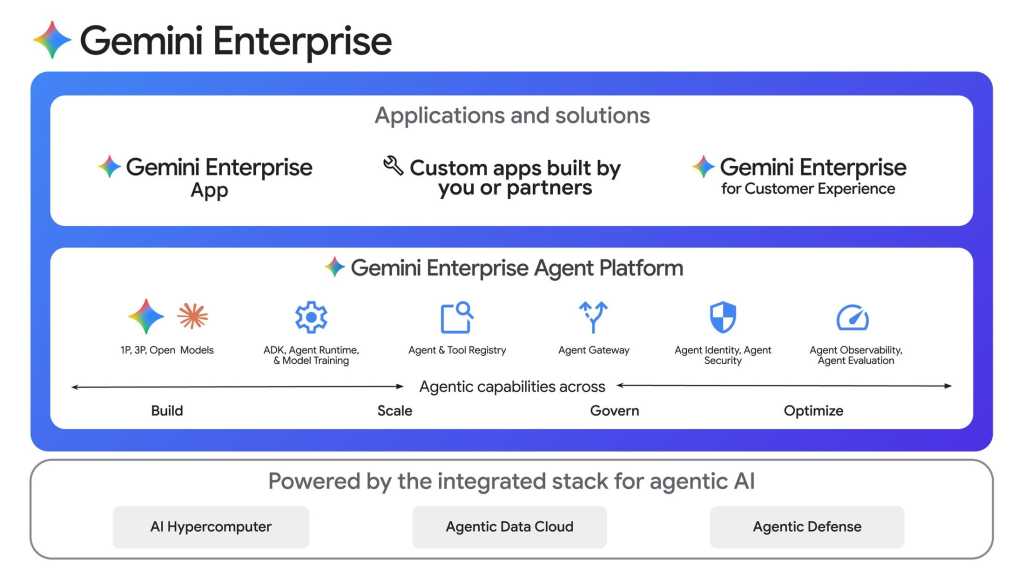
Google has updated its Gemini Enterprise app, adding new ways for office workers to build, manage, and interact with AI agents. The company also rolled out additional tools for IT teams to govern the use of agents via the new Gemini Enterprise Agent Platform.
Google first unveiled Gemini Enterprise last year, pitching it as a way for knowledge workers to access agents that can surface information and carry out tasks autonomously.
At Google Cloud Next this week, Google announced a raft of new features in the Gemini Enterprise app that are expected to be available over the “coming months.” Among these are new ways to interact with Gemini Enterprise, either independently or alongside colleagues. Projects is a new collaborative workspace that enables teams to interact with a shared “expert” chatbot that’s connected to specific data sources from Google Workspace, Microsoft 365 and team chats.
The Gemini Enterprise application is built on Google’s new Agent Platform for building and managing agents at scale.
A new Canvas tool lets users create and co-edit documents directly within Gemini Enterprise, whether that’s Google Docs and Slides, as well as Microsoft 365 files. Google is also making agents more accessible to users — and more capable.
Agent Designer, for example, is a no-code agent builder tool that lets users create “schedule- or trigger-based” agents with natural language prompts or via a visual interface. Announced in preview last year, the feature is now ready for general release in the next few weeks, providing users a “virtual flowchart” interface to inspect and test each step in an agent workflow. It’s also possible to insert human-in-the-loop checkpoints to approve actions when needed.
Then there are new “long-running” agents that can tackle more complex business processes, Google said. The agents work autonomously in cloud sandboxes, and can complete multi-step workflows such as financial reconciliations that can take days to complete.
The Agent Gallery provides access to third-party agents from the likes of Adobe, Lovable, and ServiceNow.
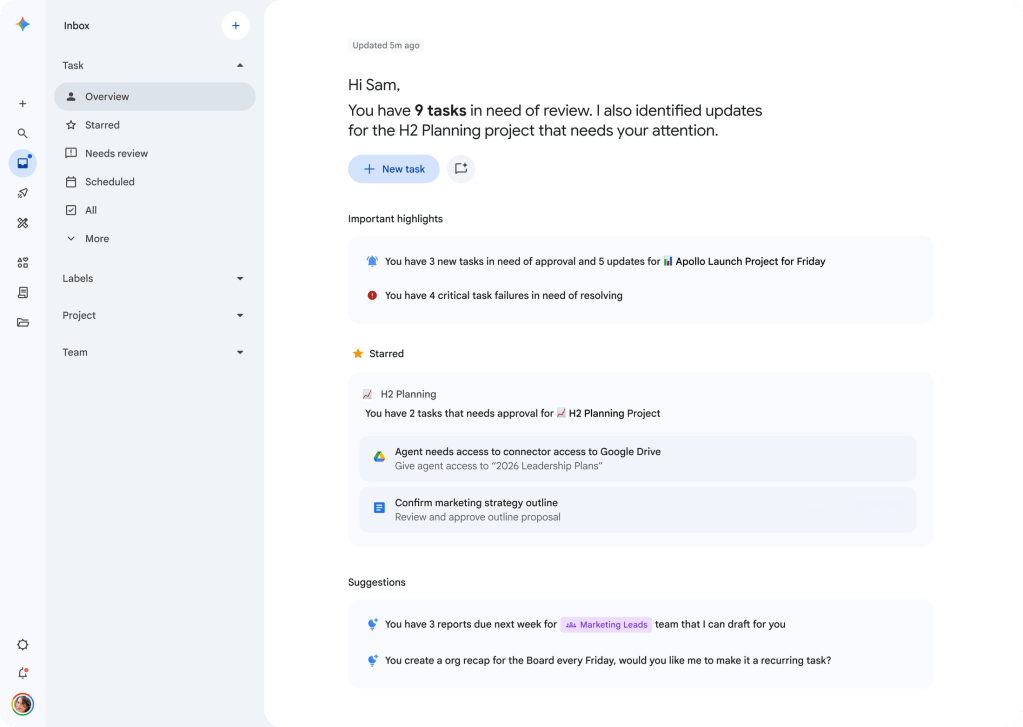
To help manage the various agents working across Gemini Enterprise, Google introduced Inbox, a “central command location to monitor, guide, and securely manage all of your agent activity,” the company announced in a blog post. That includes the long-running agents.
The Inbox tab provides a space for Gemini Enterprise users to manage agents, receive notifications, and track task completion progress.
From Inbox, users can monitor active agents and view notifications around agent actions such as “Needs your input,” “Errors,” and “Completed,” to provide a “clear, consolidated view of ongoing agent progress.”
Mike Leone, vice president and principal analyst at Moor Insights & Strategy, said that while the Project and Canvas features are “table stakes” these days when it comes to AI agents, the Inbox feature is an interesting addition. “Keeping humans in the loop when async agents are running multi-day workflows in the background is a genuinely unsolved problem, and treating agent output as a prioritized notification queue is a solid way to tackle it,” Leone said.
Gemini Enterprise costs $30 per user each month for large organizations, and $21 per user for smaller businesses. Gemini Enterprise relies on Google’s own large language models (LLMs) such as Gemini 3.1 Pro, Gemini 3.1 Flash Image, and Lyria 3, as well as third-party models such as Anthropic’s Claude Opus 4.7.
Underpinning the Gemini Enterprise app is the new Gemini Enterprise Agent Platform that’s billed as the platform to “build, scale, govern, and optimize agents,” said Michael Gerstenhaber, vice president of product management, Cloud AI, Google Cloud.
As part of the Agent Platform, Google introduced new tools at Cloud Next to help IT teams manage agents built and deployed in Gemini Enterprise. Among these is Agent Identity, which assigns a unique cryptographic ID to each agent operating in Gemini Enterprise.
“This creates a clear, auditable trail for every action an agent takes, mapped back to defined authorization policies,” said Gerstenhaber. It’s similar to Microsoft’s Agent 365 platform, where each agent is assigned a unique Microsoft Entra ID to track usage and apply risk policies.
The new Agent Registry acts as a “central library,” indexing all internal agents and skills to help IT ensure that only approved assets are accessible; Gerstenhaber described Agent Gateway as the “air traffic control” for a customer’s agents, providing “secure, unified connectivity between agents and tools across any environment.”
These are all tools that will appeal to IT as businesses start to push on with their use of agents, said Leone. “Google wants every agent action to leave the same audit trail a payroll transaction does. That’s a high bar,” he said. “Agents are going to be taking real actions on employees’ behalf at scale, and no enterprise will roll that out without knowing exactly who did what, when, and why.”
Agent Platform “sits in the same competitive neighborhood” as enterprise agent products from the likes of Microsoft, OpenAI, and AWS, said Leone, that also provide tools to build, govern, and orchestrate agents at scale.
“Implementing agentic processes is seen by most vendors as the next big opportunity to drive adoption of AI technologies in enterprise environments,” said Ed Anderson, research vice president and distinguished analyst at Gartner. “There will be a lot of competition in this area.”
according to the data Leone, Google’s edge lies in a “full-stack ownership claim few other vendors can make as cleanly, across infrastructure, models, data, security, and end-user apps,” he said. Tools such as Agent Identity, Registry and Gateway — as well as security features such as Model Armor and MCP and A2A protocols to connect agents — will help provide IT with visibility and control when running thousands of agents across business units.
“My bigger concern is that a typical IT buyer still struggles to figure out what to buy from Google and what each product actually includes as the portfolio and services have grown and evolved quickly,” said Leone.
Why it matters
News like this often changes audience expectations and competitors’ plans.
When one player makes a move, others usually react — it is worth reading the event in context.
What to look out for next
The full picture will become clear in time, but the headline already shows the dynamics of the industry.
Further statements and user reactions will add to the story.