The topic of I Ran a Subdomain Takeover Checker on GitHub.com and Found a Vulnerable Subdomain is currently the subject of lively debate — readers and analysts are keeping a close eye on developments.
This is taking place in a dynamic environment: companies’ decisions and competitors’ reactions can quickly change the picture.
I’ve been building a tool that checks subdomains for takeover vulnerabilities. Yesterday I decided to test it on a well-known target — github.com — just to see what it would find.
I wasn’t expecting much. GitHub is a massive, well-maintained platform with a serious security team. But within seconds of running the enumeration, one result came back red:
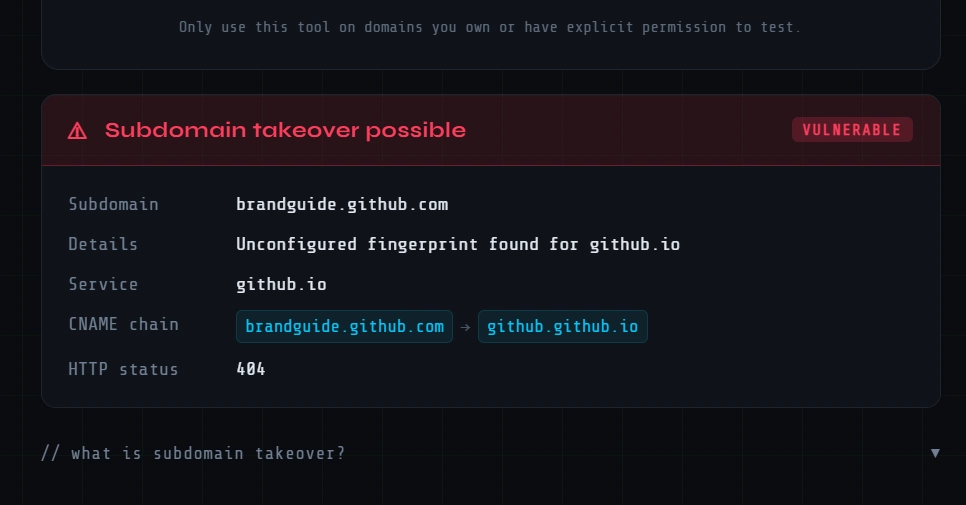
brandguide.github.com has a CNAME record pointing to a GitHub Pages address that is no longer configured. The page returns GitHub’s classic “There isn’t a GitHub Pages site here” message — which is the exact fingerprint that indicates an unclaimed Pages site.
In theory, anyone could create a GitHub Pages site at that address and serve content under brandguide.github.com — a subdomain that looks like it belongs to GitHub.
Step 1 — Enumerate subdomains via certificate transparency logs
Certificate authorities are required to publicly log every SSL certificate they issue. By querying crt.sh, you can discover subdomains that have had certificates issued — no scanning, no probing, just reading public records.
Step 2 — Check each subdomain for takeover vulnerabilities
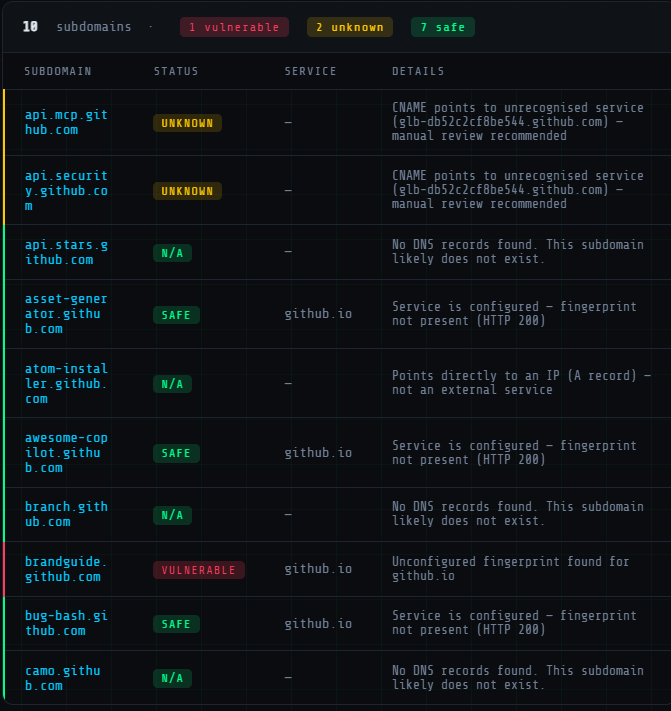
For each subdomain, the tool follows the full CNAME chain. If the final destination returns NXDOMAIN (the domain doesn’t exist) or matches a known “unconfigured” fingerprint from services like GitHub Pages, Heroku, Vercel, AWS S3, and 80+ others — it flags the subdomain as vulnerable.
brandguide.github.com passed through the CNAME chain check and matched the GitHub Pages fingerprint. Result: vulnerable.
GitHub is not unique here. Subdomains get created for marketing campaigns, staging environments, documentation sites, and internal tools — then the service gets decommissioned, but nobody cleans up the DNS record.
It’s not a sign of negligence. It’s just the natural entropy of running infrastructure at scale. The DNS record outlives the service by months or years, quietly waiting for someone to notice.
Nothing — I don’t own github.com and have no intention of claiming the subdomain. This article is purely educational. If you work at GitHub and are reading this, consider this a friendly heads up.
🔗 subdomainchecker.com — paste in a root domain, it enumerates subdomains via crt.sh and checks each one automatically
There’s also a public API if you want to integrate it into your own recon pipeline:
Are you sure you want to hide this comment? It will become hidden in your post, but will still be visible via the comment’s permalink.
For further actions, you may consider blocking this person and/or reporting abuse
DEV Community — A space to discuss and keep up software development and manage your software career
Built on Forem — the open source software that powers DEV and other inclusive communities.
Why it matters
News like this often changes audience expectations and competitors’ plans.
When one player makes a move, others usually react — it is worth reading the event in context.
What to look out for next
The full picture will become clear in time, but the headline already shows the dynamics of the industry.
Further statements and user reactions will add to the story.