The topic of I’m using Claude’s new interactive visuals to relearn everything I forgot… is currently the subject of lively debate — readers and analysts are keeping a close eye on developments.
This is taking place in a dynamic environment: companies’ decisions and competitors’ reactions can quickly change the picture.
At some point in high school, I just accepted that some subjects weren’t for me and instead tried to focus on the stuff I was good at. For me, that was mostly chemistry – I was completely lost in that class, and even years after graduating high school, it still bothers me that I didn’t know what was going on. I always told myself I’d go back and relearn everything I either didn’t understand, or did and just forgot – but life got in the way.
The funny thing is the busy schedule I kept blaming is kind of what got me there. I have Claude open for a big portion of the day now – it cuts down the number of times I have to re-type something in a browser, helps me quickly get overviews of large docs, and helps me organize the files on my PC too. It’s probably the most helpful AI tool I’ve used across the board.
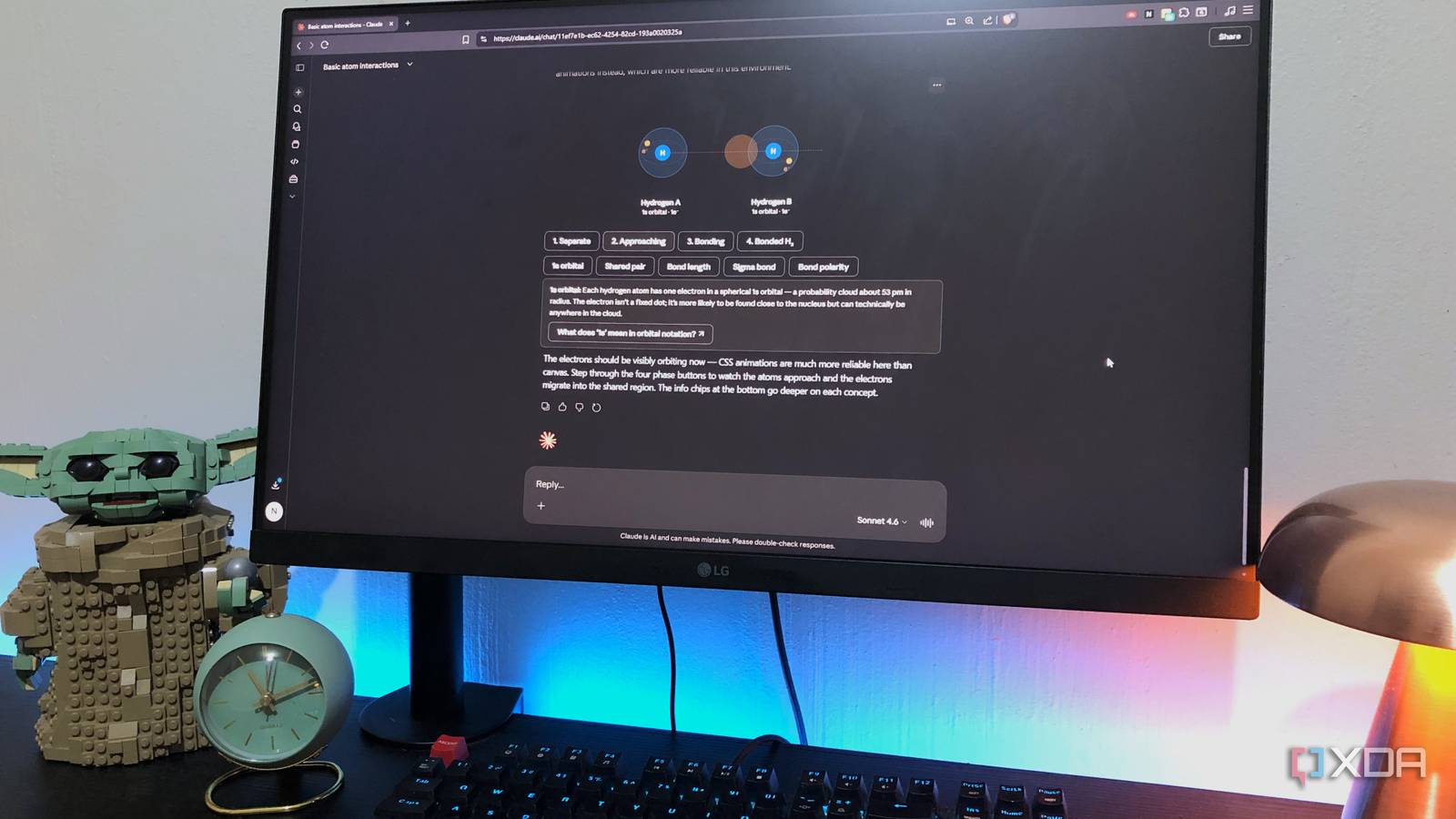
When Claude rolled out the interactive inline visuals last month, my first instinct was to use them for my current design coursework – that was the obvious fit. But then I started thinking about other use cases and chemistry is actually really visual, there’s a lot going on that a text explanation can only do so much with. So I figured, why not go back to shool?
Some things just don’t translate into text. You can get a perfectly clear explanation of something and still have no idea what’s actually happening because the thing itself is dynamic – it moves, changes its state, or has parts that interact. And words can only describe that sequentially. Chemistry was the obvious example for me, but it’s the same problem with anything spatial or process-driven. You can only learn so much from a static textbook, web page, or PDF doc. YouTube works if you find the right video and land at the right moment. Asking Claude for a text explanation just gives you a more thorough version of the same format. The information was never really the gap.
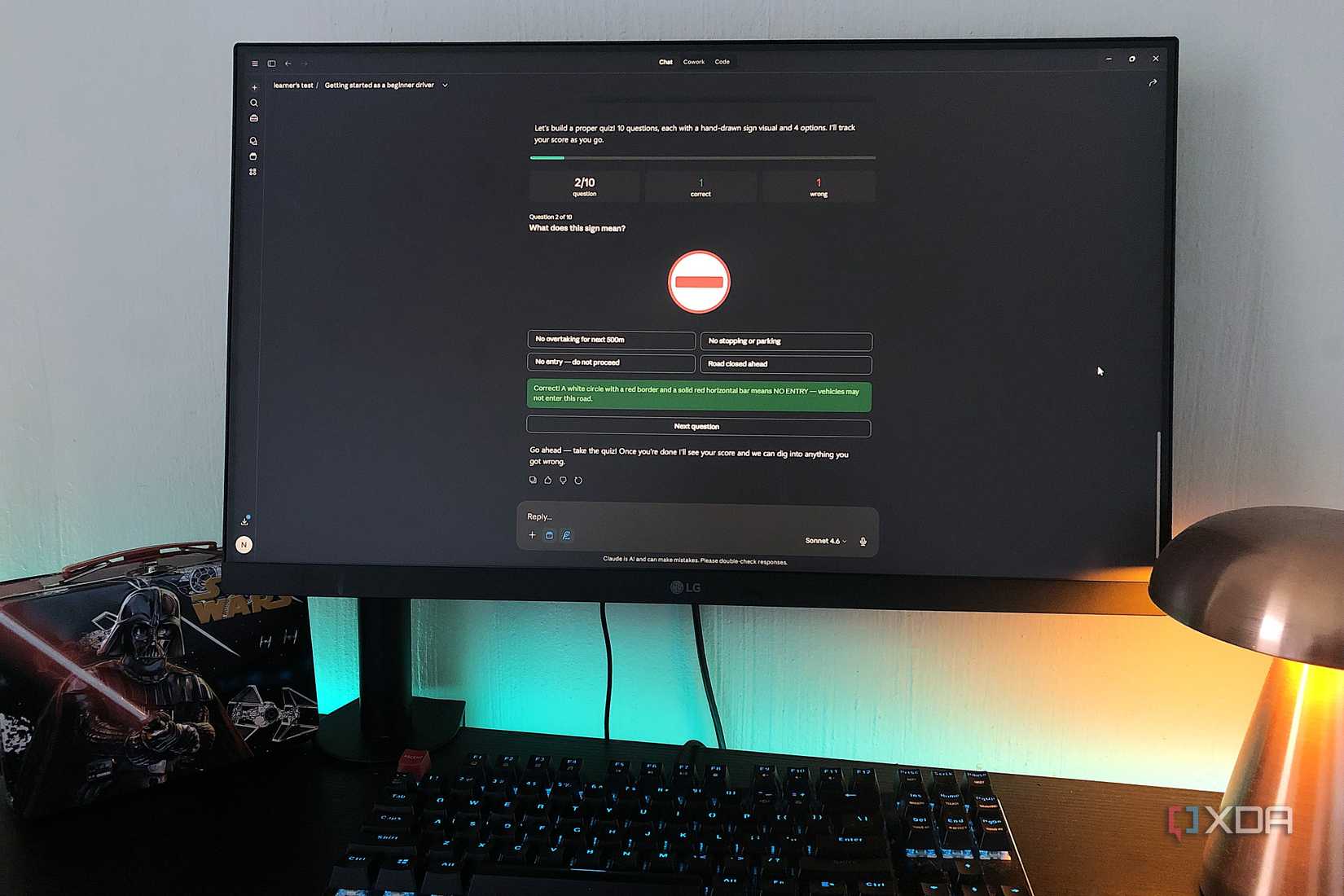
What the interactive visuals actually do is change the format of the answer. Not a better explanation of the same thing – a different kind of thing entirely. The interactivity is what separates it from every other way of explaining something that’s hard to picture. Reading is passive. But sliders and toggles aren’t. And the best part is that you don’t need sources or reference materials, Claude fetches everything it needs from its training data or the web. I actually also studied for my learner’s licence test using the new visuals.
I’m just using chemistry as the demonstrator here because it’s something I actually did recently, but these tricks I found are applicable to most other subjects. The first thing worth knowing is that Claude decides when to generate a visual, but you can always just ask. Phrases like “draw this as a diagram” or “show me how this changes over time” will trigger it pretty reliably.
For chemistry specifically, something like “show me this reaction step by step, I want to watch it move, not just read the steps” tends to force a dynamic output rather than a static one. If you ask and get text anyway, just rephrase and specifically ask for an interactive visual, and be explicit about what you want to see – sliders, toggles, drawings, etc.
I also describe what I want the visual to do, not how to build it. Claude makes better decisions when it understands the goal rather than the construction. “Make me a diagram of electron movement” is vague in the wrong direction. “Show me what happens to electrons during a covalent bond, I want to see them moving between atoms, with labels I can click for more detail” is better because it gives Claude the goal, the inputs, and what should be interactive.
Also tell it who’s learning. Claude calibrates complexity based on context, and it actually uses that information. “This is for someone seeing this for the first time” and “this is for someone who needs a quick refresher” produce genuinely different visuals. And don’t scrap a visual just because it’s not quite right. The first output is a starting point. Follow-up prompts work just as well as the first one – for example, “now add a variable for temperature” or “can you isolate just this step”.
This last one is probably the most underrated. If you’ve already been talking through a concept in text before asking for a visual, Claude already knows what you do and don’t understand. The visual it builds after that context is smarter than one you’d get by opening with the visual request cold.
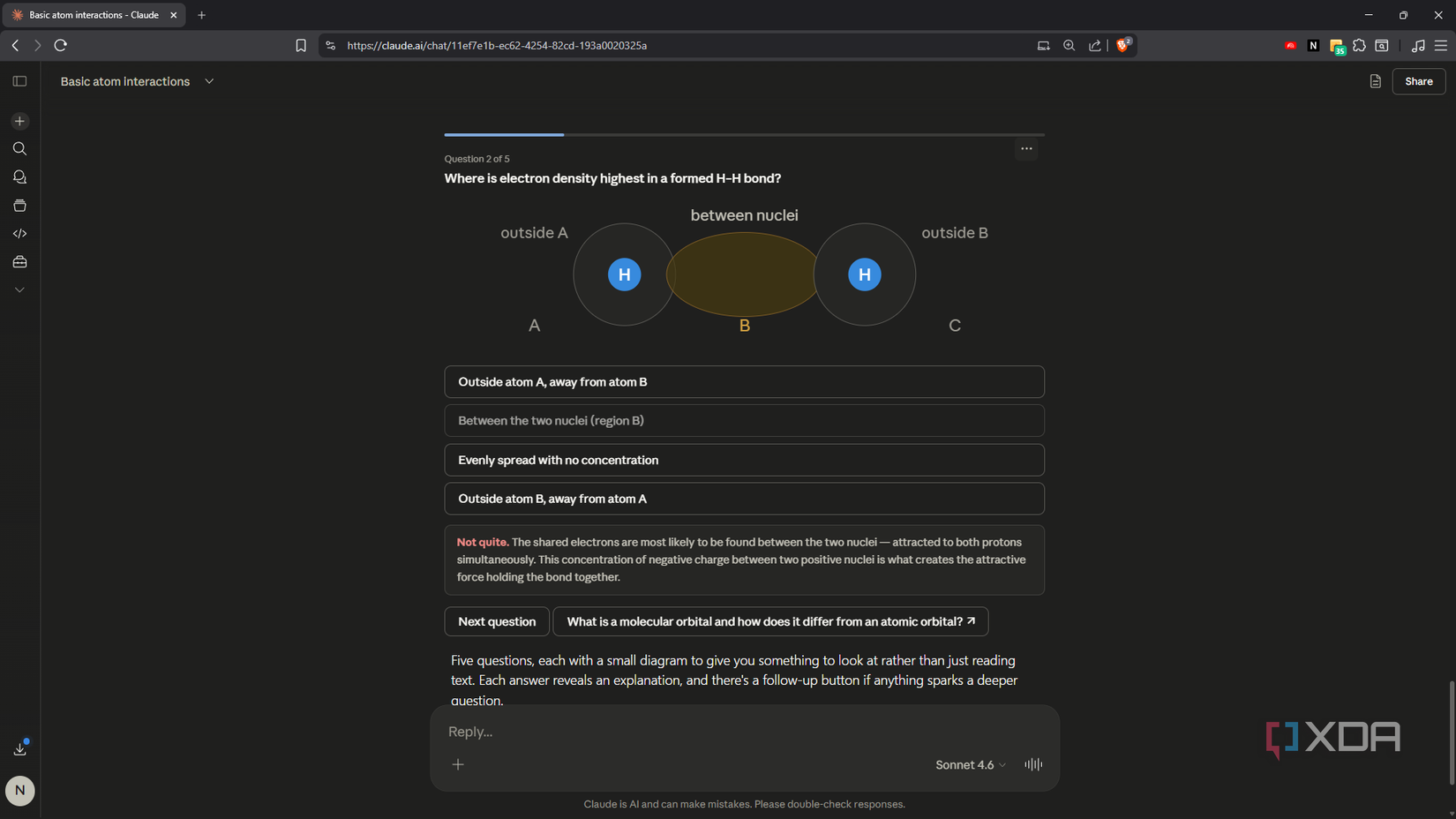
The visual does the explaining but it doesn’t do the learning. Once it’s done its job, there’s a follow-up worth building into the habit – just ask Claude to quiz you on what you just saw. It already knows exactly what the visual covered, so the questions are specific rather than generic. For chemistry especially, where everything builds on the last thing, finding a gap before moving forward saves a lot of backtracking.
If a visual lands well, it’s worth keeping. Saving it as an artifact makes it persistent and reopenable across sessions. Downloading as HTML is the other option – the interactions survive but the aesthetics take a hit, the CSS doesn’t always translate cleanly outside the interface. Functional, a little rough. Fine for personal reference.
Chemistry still isn’t easy, but it’s the first time I’ve actually felt like I know what’s happening at a molecular level – even if only barely. The interactive visuals are doing a lot of that heavy lifting, but the prompting habits matter just as much. Describe the goal, build context before asking, iterate rather than restart. And if you’re using this for anything with sequential concepts, the quizzes at the end or throughout is a habit worth picking up early.
Why it matters
News like this often changes audience expectations and competitors’ plans.
When one player makes a move, others usually react — it is worth reading the event in context.
What to look out for next
The full picture will become clear in time, but the headline already shows the dynamics of the industry.
Further statements and user reactions will add to the story.