The topic of We Built an Open-Source Coding Exam Platform Because Every Vendor Let Us Down is currently the subject of lively debate — readers and analysts are keeping a close eye on developments.
This is taking place in a dynamic environment: companies’ decisions and competitors’ reactions can quickly change the picture.
Every year, our team visits engineering colleges across India to hire freshers. The first round is always an online coding test — 300+ students, one shot at finding the ones who can actually think.
We tried Coderbyte. Fifty concurrent user limit. So we’d split students into batches, stagger timings, juggle schedules between college coordinators and our engineers.
Every vendor had a ceiling — concurrency limits, inflexible problem formats, generic DSA questions that tested memorization over problem-solving. And the pricing? Designed for companies ten times our size.
I was ranting about this to my engineering team. Out loud. In our standup. Trying to find yet another vendor to evaluate.
My engineers — most of them freshers themselves just a couple years ago — went quiet. Said nothing for a few days.
Then they shipped a product. Two engineers. One weekend. AI-assisted development. And two days of intensive testing before it went live.
A full-stack, self-hosted coding exam platform. Not a toy. Not a prototype. A production system we ran 300+ students through this hiring season.
Monaco Editor — the same engine that powers VS Code. Syntax highlighting, autocomplete, multi-language support. Students write real code, not paste answers into a textarea.
Judge0 Sandboxed Execution — every submission runs inside a sandboxed Judge0 instance. Test cases execute in parallel with automatic batching. Students get instant, per-test-case verdicts.
ICPC-Style Scoring — not just pass/fail. Penalty points for wrong attempts. Time-based ranking. Race-condition-safe writes to the database. The leaderboard feels like a competitive programming contest, not a homework checker.
Live Leaderboard — backed by a PostgreSQL materialized view that refreshes after every accepted submission. O(1) rank queries. Students watch themselves climb in real-time.
API-Based Challenges — beyond traditional stdin/stdout problems, we built support for API-format challenges where students interact with real endpoints. This lets us test how candidates think about integration, not just algorithms.
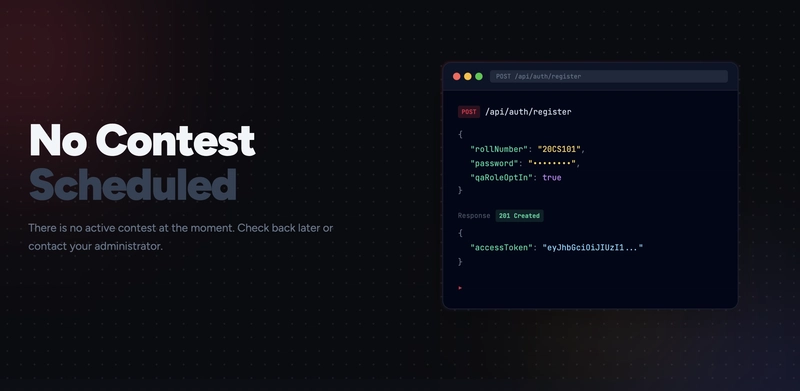
Server-Synced Timer — the countdown runs on server time, not the client clock. No inspect-element tricks. Configurable start/end windows with server-enforced access guards.
Autosave — code drafts are debounce-saved to the server every few seconds. Browser crash? Tab closed? The student picks up right where they left off.
White-Label Ready — app name, logo, brand colors, copyright — all configurable via environment variables. Zero code changes. We use it as our own branded platform; anyone can make it theirs.
In production, the server compiles and serves the client’s static build directly — no separate web server or CDN needed.
Frontend: Vue 3 (Composition API), Vite 8, TypeScript 5.9, Pinia 3 for state, Monaco Editor 0.55, Brotli compression
Backend: NestJS 11, TypeScript 5.7, TypeORM 0.3, Passport JWT, Swagger/OpenAPI docs, rate limiting via @nestjs/throttler
Database: PostgreSQL 17 for the application, PostgreSQL 16 + Redis 7.2 for Judge0’s internal queue
Infrastructure: Docker Compose orchestrates six services — app, app-db, judge0-server, judge0-worker, judge0-db, and judge0-redis. Multi-stage Dockerfile produces a minimal Node 22-alpine image running as a non-root user.
Here’s what we built because we needed it, not because a product manager spec’d it:
We built it because we were tired of bending our hiring process around someone else’s product limitations. And once we had it, we realized every small company visiting colleges faces the exact same problem.
Here’s the thing that makes this story worth telling: two engineers built this in a weekend, with AI doing the heavy lifting on scaffolding, boilerplate, and iteration. Then two days of intensive testing to harden it for production. That’s the power of AI-assisted development — it doesn’t replace engineers, it turns two of them into ten.
In the AI era, expensive hiring software shouldn’t be a gate that keeps small teams from finding great talent. If two engineers with AI tools can build a platform that handles 300+ concurrent students with ICPC scoring and sandboxed execution in a weekend, there’s no reason that capability should be locked behind enterprise pricing.
The whole thing is AGPL-3.0 licensed. Fork it, brand it, run it on your own infrastructure — just keep your modifications open too.
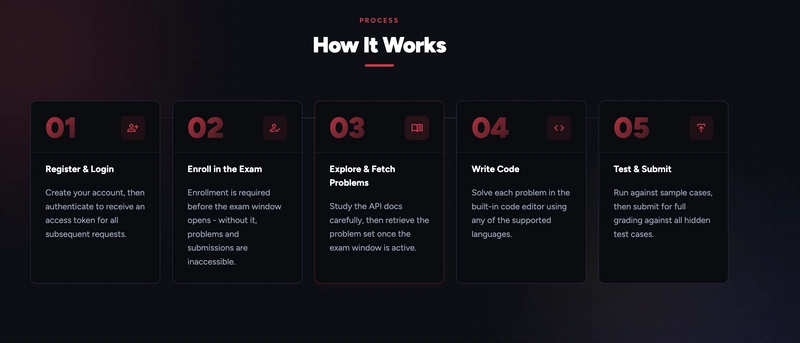
Six services start in dependency order. The app waits for the database health check, runs migrations automatically, and you’re live.
For local development without Docker, you’ll need PostgreSQL 17 and a Judge0 instance. The README walks through every step — database creation, migrations, environment variables, and running the frontend and backend separately.
If you’re interested, follow me here — I’ll drop the GitHub link as soon as the repo goes public.
Two engineers. One weekend of building. Two days of intensive testing. Powered by AI-assisted development. A platform that replaced two commercial tools and produced measurably better candidate quality in round two.
That’s what happens when you hire people for intent over resumes — and then get out of their way.
Built with Vue 3, NestJS, PostgreSQL, Judge0, and a healthy disregard for vendor lock-in.
Star the repo when it drops. Or better yet — fork it and run your own hiring season on it.
Are you sure you want to hide this comment? It will become hidden in your post, but will still be visible via the comment’s permalink.
For further actions, you may consider blocking this person and/or reporting abuse
DEV Community — A space to discuss and keep up software development and manage your software career
Built on Forem — the open source software that powers DEV and other inclusive communities.
Why it matters
News like this often changes audience expectations and competitors’ plans.
When one player makes a move, others usually react — it is worth reading the event in context.
What to look out for next
The full picture will become clear in time, but the headline already shows the dynamics of the industry.
Further statements and user reactions will add to the story.