There is fresh movement around Neil Armstrong’s Famous Moon Landing Quote Has Been Misheard for Decades, and the story is worth a closer look.
We pulled together what is known so far and what it could mean for the people following it.
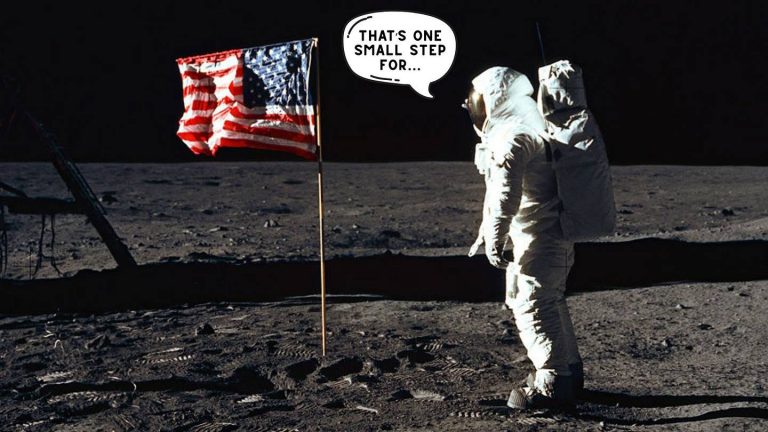
Neil Armstrong never actually said, "one small step for man, one giant leap for mankind." Well, not exactly, anyway.
Speaking to the press in the days after the Apollo 11 spacecraft landed on the moon, the astronaut who took the historic first step admitted that people watching on TV and listening on the radio misheard him.
So, what did Neil Armstrong really say? And does it change the meaning of a line that's been printed in history books for decades? Let's set a course back to that momentous day and shed light on the true contents of Armstrong's famous phrase.
Commander Neil Armstrong and Pilot Buzz Aldrin made contact with the moon on July 20, 1969, a first for humanity and a groundbreaking success, but their journey began four days prior.
The astronauts, accompanied by a third crew member, Michael Collins, boarded Apollo 11 on the morning of July 16 and launched into space at approximately 9:32 a.m. EDT, soaring high above Cape Kennedy, where more than a million spectators, including former President Lyndon B. Johnson, gathered in anticipation and awe.
The trio spent three days drifting through space before Armstrong and Aldrin, manning the Lunar Module, touched down on the moon at 4:17 p.m. on July 20. Collins remained aboard the Command Module Columbia, taking photos and relaying communications to Earth.
Armstrong was the first to exit the module at 10:51 p.m., with Aldrin (literally) following in his footsteps. Five minutes later, Armstrong uttered the words that would transcend time and be immortalized in history.
"That's one small step for man, one giant leap for mankind," he announced…or so everyone assumed.
After collecting rock samples and staking the American Flag into the lunar surface, the astronauts returned to Earth, splashing down in the Pacific Ocean at 12:51 p.m. on July 24. Upon completing a 21-day quarantine, Armstrong spoke to the press and explained that his message was incorrectly transcribed.
He thought he'd said, "That's one small step for a man, one giant leap for mankind," which intensifies the contrast between the two halves of the phrase. Without the "a," the phrase essentially means, "That's one small step for humanity, one giant leap for humanity."
Adding the "a" makes Armstrong's intended meaning easier to interpret: the moon landing was a physically small act for him as an individual, but a colossal achievement for humanity and the advancement of space exploration.
Armstrong listened to the recording years later and admitted that he couldn't hear himself say "a" either. In 2006, computer programmer and speech analyst Peter Shann Ford used modern equipment to analyze the recording and concluded that the astronaut did, in fact, say "a," but it was muffled by static.
Regardless of what was said or what was heard, the action speaks for itself. Armstrong really did take a small step onto the moon in 1969, and it really was, then and now, a giant leap for humanity.
Humans have returned to the moon only ten times since Apollo 11, with the last mission, Apollo 17, completing its journey to and from the celestial body in 1972.
The crew of Artemis 4 plans to explore the moon's South Pole in 2028, a region yet to be traversed by humans. China also aims to send astronauts to the moon in 2030 as part of its Lunar Exploration Program. These will be the first crewed moon landings since Apollo 17.
About the Author