The topic of Beyond Vibe Coding into Agentic Engineering is currently the subject of lively debate — readers and analysts are keeping a close eye on developments.
This is taking place in a dynamic environment: companies’ decisions and competitors’ reactions can quickly change the picture.
In 2025 I published a blog post titled Common security pitfalls using Vibe coding, where I briefly explained what vibe-coding is, and what the security issues arise from “vide coding”.
Recently, I came across an emerging term called “Agentic Engineering”.
In this blog post, I will explain what “Agentic Engineering” is and how it differs from “Vibe coding”.
The term “Vibe coding” came from a quote by Andrej Karpathy on Twitter/X. It refers to the “magical” experience of typing English into an editor (like Cursor) and watching a feature appear. It relies on the model’s training data to guess the intent.
Vibe coding is basically when you treat building software like a “vibes only” project. You ask an AI for something, hit copy-paste without really looking at what it gave you, and just cross your fingers that it works. If it breaks, you just throw the error message back at the AI and hope the next try is better. It turns programming into a lucky guess rather than a real skill. The big issue right now is that people are confusing this “winging it” approach with actual professional work, and that’s a dangerous mistake to make.
Vibe coding isn’t ready for the big leagues because it’s like building a house with a “magic” hammer that does the work for you, but you have no idea how the plumbing or wiring actually connects behind the walls. When you just accept whatever, the AI gives you, you might unknowingly be leaving the front door unlocked for hackers because you didn’t check the security. Even worse, if something breaks six months from now, your human team will be stuck staring at a confusing mess of code they didn’t write and don’t understand. It’s nearly impossible to fix or update a system when the people in charge don’t know the “why” behind how it was built in the first place.
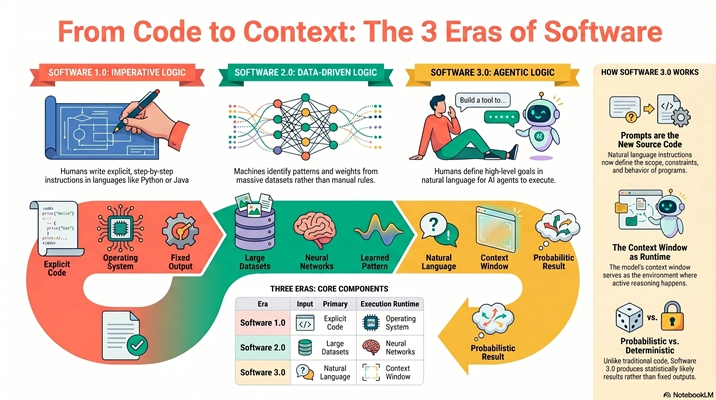
The evolution from Software 1.0 to Software 3.0 is most commonly referred to as the Software Paradigms or the Generations of Programming.
Each stage represents a fundamental shift in how humans interact with machines and how logic is generated.
Agentic Engineering describes a shift from using AI as a simple autocomplete tool to using it as a semi-autonomous agent capable of reasoning, using tools, and correcting its own mistakes.
While the concept of “Software Agents” dates back to the 1990s, the modern term gained momentum in late 2023 and early 2024. Industry leaders like Andrew Ng (via DeepLearning.AI) have championed the “Agentic Workflow,” arguing that iterative agent loops often produce better results than larger, more powerful models using simple zero-shot prompting.
In standard development, a human writes the logic. In Agentic Engineering, a human defines the goal and the constraints, while an agentic system performs the following:
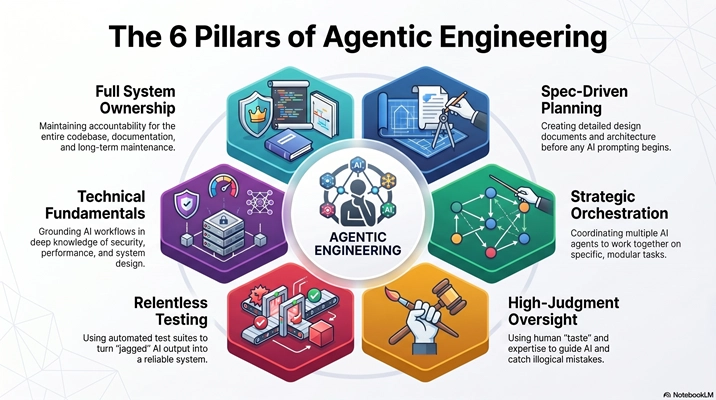
When experts like Andrej Karpathy or Addy Osmani discuss the shift to agentic engineering, they often talk about six core principles that define the workflow. These include the structure above, but add the “how-to” of professional engineering:
Vibe coding relies on intuition and a “guess-and-check” workflow where a developer prompts an AI and hopes the output works. While fast for prototyping, this approach lacks the structure needed for complex systems because it depends on the human to spot errors and manage the logic. The shift to agentic engineering replaces this experimental style with a professional discipline. Instead of a single chat, you build a system where the AI acts as an autonomous agent that creates a formal plan, executes tasks in small steps, and uses a self-correcting loop to fix its own mistakes before delivering the final result.
The core of this transition is moving from being a writer of code to a strategic orchestrator. You provide the high-judgment oversight and define the technical fundamentals, while the agent takes full system ownership of the implementation. By implementing spec-driven planning and relentless testing, the agent ensures that every line of code is verified against real-world requirements. This move from “vibes” to “engineering” creates a reliable, scalable factory for software where the focus is on building robust systems rather than just chasing a lucky output.
Disclaimer: AI tools were used to research and edit this article. Graphics are created using AI.
Reference:
Eyal Estrin is a cloud and information security architect and AWS Community Builder, with more than 25 years in the industry. He is the author of Cloud Security Handbook and Security for Cloud Native Applications.
The views expressed are his own.
Are you sure you want to hide this comment? It will become hidden in your post, but will still be visible via the comment’s permalink.
For further actions, you may consider blocking this person and/or reporting abuse
Would you like to become an AWS Community Builder? Learn more about the program and apply to join when applications are open next.
DEV Community — A space to discuss and keep up software development and manage your software career
Built on Forem — the open source software that powers DEV and other inclusive communities.
Why it matters
News like this often changes audience expectations and competitors’ plans.
When one player makes a move, others usually react — it is worth reading the event in context.
What to look out for next
The full picture will become clear in time, but the headline already shows the dynamics of the industry.
Further statements and user reactions will add to the story.