I was one click away from paying for Google Photos, then I found this hidden setting — here is a clear breakdown of what happened and why it matters right now.
The details below put the news in context: the key points first, the background after.
My storage bar had been sitting in the red for months, slowing approaching full, and every notification about it made me want to permanently disable the app.
I was one click away from a Google One upgrade before I bothered to check whether the settings could help me out.
Part of the reason I’d hesitated was that all the fixes sounded like something I’d regret. Letting Google delete almost 150GB of backed-up photos and videos is terrifying, but a colleague apparently had a better time of it than I expected.
These settings could dig me out. The last one I found gave me back more space than the other four combined, and I only heard about it because someone mentioned it in passing.
When I set up Google Photos years ago, it asked whether I wanted originals backed up at full quality. I had an empty cloud folder and a trial with more space than I thought I’d ever use, so I picked Original quality without thinking about it.
Over the years, as phone cameras have become better and my reference folder has multiplied, it’s clear that the choice aged rather badly.
Storage Saver caps photos at 16MP and videos at 1080p, and it works on most compatible media files. Some shots, like Portrait mode JPGs, can’t be compressed at all.
So, I switched to Storage Saver from Original Quality. For work and hobby shoots, I’d already been recording at higher quality anyway, and I back up those elsewhere.
This setting only affects new uploads, and this caveat is not immediately obvious at setup. It slows the bleeding, but doesn’t touch the years of high-quality photos already sitting in your account.
Google Photos has let you pick individual local folders since 2014, but I’ve never once opened that list.
At some point, I’d enabled backup for all device folders, including auto-syncing any new folder that appeared. As a result, every folder in my gallery was going to the cloud regardless of what was in it.
That includes hundreds of memes and reaction videos I’d forgotten about years ago, as well as every screenshot I’d ever taken, plus all the duplicates copied into various folders and forgotten.
I toggled off the offenders and deleted what was already uploaded, but that barely made a dent in the storage usage number.
Google Photos holds deleted items for 60 days before permanently removing them, and they count against your quota the entire time.
That’s a reasonable safety net most of the time. But it’s frustrating when you’re desperately deleting things to get under a limit, and the bar refuses to move.
I could delete 10GB of video, and they’d still count towards my total in a month. Trash folders are useful enough that even Google Messages is getting one, but they’re the first thing you forget when you’re panicking.
Clearing it out finally made the deleted items actually leave the storage, and that took the red down a notch.
Under Photos settings > Backup > Manage storage, Google lists categories you can clean up, such as blurry photos, screenshots, large photos and videos, plus large Gmail attachments and files sitting in your Drive trash.
It’s not clever, but it’s accurate. A lot of what it showed me needed to go, and I wouldn’t have been able to find them by scrolling.
I made my picks and moved a few percentage points further from the line. At this point, I figured I’d exhausted the options and prepared my wallet for a Google One upgrade.
From smart albums to AI magic — how well do you really know Google’s beloved photo platform?
In what year was Google Photos launched as a standalone app, separate from Google+?
Google Photos ended its free unlimited original-quality storage policy in June 2021. What storage cap applies to free Google accounts?
What is the name of Google Photos’ AI-powered feature that automatically groups photos by the people who appear in them?
Which Google Photos feature allows you to remove distracting objects or people from a photo using generative AI?
What is the name of the Google Photos feature that automatically shares relevant photos with friends or family members it recognises in your pictures?
Which Google Photos editing tool uses AI to suggest brightness, contrast, and color adjustments tailored specifically to each photo?
Google Photos allows users to lock sensitive photos behind biometric authentication. What is this protected space called?
I was telling a friend how much progress I’d made when they asked whether I’d converted my existing library. I hadn’t, because I didn’t know you could.
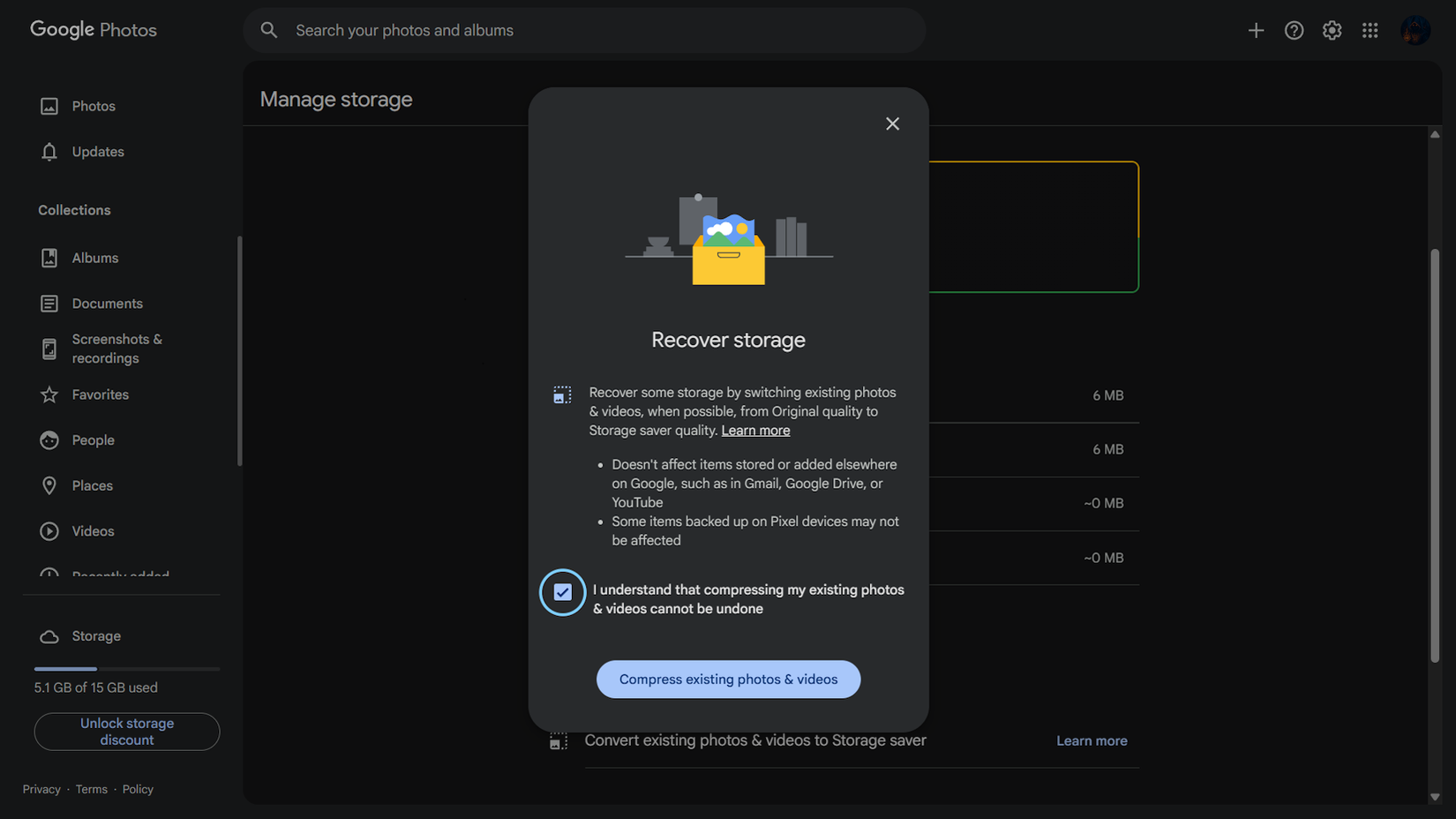
I found it on the web client at photos.google.com, under Settings > Manage storage > Recover storage > Convert existing photos & videos to Storage saver. Android has been getting an in-app version of this, so check your app before booting up a computer.
When it finished running, I was under 50% usage, from a library that had been nearly full for the better part of a year.
Two things you should know before you click it. It’s all or nothing, so you can’t protect specific shots from compression while converting the rest, and it permanently rewrites the files in your account.
Anything you care about at full resolution needs to live somewhere else first.
Buying storage would have bought me maybe a year before the same notification came back, because the real issue wasn’t a capacity problem.
Every folder I’d never audited, and every original quality file I didn’t need would still have been there, just with more room to grow.
The truth is that I traded image resolution for space, permanently, on a library I can’t get back. Someone who shoots photographs for a living would likely not do what I did, and someone paying $2 a month to skip the decision has a defensible position.
This works for me because almost nothing in my account needs to be full resolution, and the things that do are already backed up elsewhere.
If I upgrade later, at least I’ll be paying for space I’m actually using, and I’d still like Google to add a proper duplicate removal tool like the one Samsung Gallery has so that I don’t have to run a manual audit next time.
About the Author